HECToR
For queries about this topic, contact Ian Bush.
View the calendar of events relating to this topic.
Projects
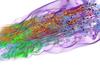
Advanced modelling for two-phase reacting flow
Edward Richardson (Investigator)
Engine designers want computer programs to help them invent ways to use less fuel and produce less pollution. This research aims to provide an accurate and practical model for the injection and combustion of liquid fuel blends.
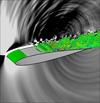
Aerofoil noise
Richard Sandberg (Investigator)
High-performance computing is used to identify noise sources on aerofoils.
Body Forces in Particle Suspensions in Turbulence
Gabriel Amine-Eddine (Investigator)
The behaviour of multiphase flows is of primary importance in many engineering applications. In the past, experimental observations have provided many researchers with the ability to understand and probe the phenomena and physical processes occurring in such flows. With advancements in modern day computational power, we now have the ability to gain an even greater wealth of knowledge, from what used to be a physical experiment, is now a virtual simulation.
Amine-Eddine, G.H. (2015) Body forces in particle suspensions in turbulence. University of Southampton, Faculty of Engineering and the Environment, Doctoral Thesis , 283pp.

Complex Systems Simulations Centre for Doctoral Training
Jonathan Essex, Seth Bullock, Hans Fangohr (Investigators)
The centre for doctoral training brings together students from a variety of backgrounds, ranging from mathematics, physics and chemistry to oceanography, geography, biology, computer science, and engineering. Students carry out a four-year programme combining taught courses with a PhD project.

Computational Fluid Dynamics of Compressor Blades Within a Gas Turbine Engine (HiPSTAR)
Richard Sandberg (Investigator), John Leggett
As modern engines become more and more efficient, the importance of understanding the finer details of the physics involved grows, if further gains are to be achieved. In such harsh enviroments, such as within a gas turbine engine, there are few means of studying them physicaly and we are left with little choice but to use super computers to model the flow.
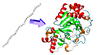
Deep Optimisation
Jamie Caldwell
The project will develop the implementation and application of a new optimisation technique. 'Deep optimisation' combines deep learning techniques in neural networks with distributed optimisation methods to create a dynamically re-scalable optimisation process. This project will develop this technique to better-understand its capabilities and limitations and develop GPU implementations. The protein structure prediction problem will be used as the main test application.
Development of a novel Navier-Stokes solver (HiPSTAR)
Richard Sandberg (Investigator)
Development of a highly efficient Navier-Stokes solver for HPC.
Development of wide-ranging functionality in ONETEP
Chris-Kriton Skylaris (Investigator), Jacek Dziedzic
ONETEP is at the cutting edge of developments in first principles calculations. However, while the fundamental difficulties of performing accurate first-principles calculations with linear-scaling cost have been solved, only a small core of functionality is currently available in ONETEP which prevents its wide application. In this collaborative project between three Universities, the original developers of ONETEP will lead an ambitious workplan whereby the functionality of the code will be rapidly and significantly enriched.

Direct Numerical Simulations of transsonic turbine tip gap flow
Richard Sandberg (Investigator)
Direct Numerical Simulations are conducted of the transsonic flow through the tip gap at real engine conditions.

Eddy-resol?ving Simulation?s for Turbomachi?nery Applicatio?ns
Richard Sandberg (Investigator), Li-Wei Chen
Traditionally, the design of turbomachinery components has been exclusively accomplished with steady CFD, with Reynolds Averaged Navier-Stokes (RANS) models being the predominant choice. With computing power continuously increasing, high-fidelity numerical simulations of turbomachinery components are now becoming a valuable research tool for validating the design process and continued development of design tool.
In the current project, Direct Numerical Simulations (DNS) and other eddy-resolving approaches will be performed of turbomachinery components to establish benchmark data for design tools, and to investigate physical mechanisms that cannot be captured by traditional CFD approaches.
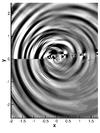
Effects of trailing edge elasticity on trailing edge noise
Richard Sandberg (Investigator), Stefan C. Schlanderer
This work considers the effect of trailing edge elasticity on the acoustic and hydrodynamic field of a trailing edge flow. To that end direct numerical simulations that are fully coupled to a structural solver are conducted.
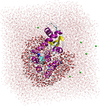
Electrostatic embedded energy calculations of proteins, using the ONETEP DFT code
Chris-Kriton Skylaris (Investigator), Stephen Fox, Chris Pittock
Calculating the energy of a biomolecule in solvent, using quantum mechanics (QM) is possible, but extremely challenging, even with linear-scaling QM methods like ONETEP. Using electrostatic embedding, a novel twist on the existing QM/MM method is used to calculate the binding energy of a small ligand to a solvated protein, increasing the accuracy and realism of our general project work.

How sensitive is ocean model utility to resolution?
Kevin Oliver (Investigator), Maike Sonnewald
One of the most intriguing problems in recent ocean modeling research is the impact of varying model resolution on model accuracy. Increasing model resolution one includes more of the important processes. However, the increase in accuracy with resolution is unlikely to be linear. Thus, as computational cost increases with resolution, a critical assessment of achieved benefits is prudent. Here we analyse a suite of realistic and compatible global ocean model runs from coarse (1o, ORCA1), eddy-permitting (1/4o, ORCA025) and eddy resolving (1/12o, ORCA12) resolutions. Comparisons of steric height variability (varSH) highlight changes in ocean density structure, revealing impacts on mechanisms such as downwelling and eddy energy dissipation. We assess vertical variability using the covariace of the deep and shallow varSH. Together with assessing isopycnal movements, we demonstrate the influence of deep baroclinic modes and regions where the barotropic flow sheds eddies. Significant changes in the deepwater formation and dispersion both in the Arctic and Antarctic are found between resolutions. The varSH increased from ORCA1 to ORCA025 and ORCA12, particularily in the Southern Ocean and Western Boundary Currents. However, there is no significant covariance between the surface and deep in ORCA1, while ORCA025 and ORCA12 show significant covariance, implying an important missing energy pathway in ORCA1. Comparing ORCA025 and ORCA12 we see significant differences in eddy energy dissipation. We assess the impact of varying model resolution on the mean flow, discussing implications to dissipation pathways on model accuracy, with reference to stochastic parameterisation schemes.
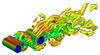
Hybrid RANS/LES methods
Richard Sandberg (Investigator), Markus Weinmann
Novel hybrid RANS/LES methods are developed for more accurate and efficient simulation of flow over complex geometries.
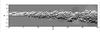
Is fine-scale turbulence universal?
Richard Sandberg (Investigator), Patrick Bechlars
Complementary numerical simulations and experiments of various canonical flows will try to answer the question whether fine-scale turbulence is universal.
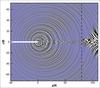
Jet noise
Richard Sandberg (Investigator), Neil Sandham
Direct numerical simulations are used to investigate jet noise.
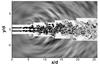
Numerical investigation of the true sources of jet noise
Anurag Agarwal (Investigator), Samuel Sinayoko
Aircraft noise severely impacts the quality of life of people living close to airports. Noise generation by aircrafts is especially large during take-off. Jet noise is the dominant noise source during take-off. It is produced by the high speed flow generated by the engine. However, the actual source of sound remains unknown. A deeper understanding of the sources of jet noise is need to be able to reduce the noise. The aim of this project is to implement a innovative method that would allow to identify the sources of jet noise.
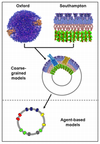
OMSys Towards a system model of a bacterial outer membrane
Syma Khalid (Investigator)
Many bacteria have an outer membrane which is the interface between the cell and its environment. The components of this membrane are well studied at an individual level, but there is a need to model and understand the outer membrane as a whole. In this project we aim to develop such a model of a bacterial outer membrane, linking computer simulations of the component molecules through to a more "systems biology" approach to modelling the outer membrane as a whole. Such an approach to modelling an OM must be multi-scale i.e. it must embrace a number of levels ranging from atomistic level modelling of e.g. the component proteins through to higher level "agent-based" modelling of the interplay of multiple components within the outer membrane as a whole. The different levels of description will be integrated to enable predictive modelling in order to explore the roles of outer membrane changes in e.g. antibiotic resistance.
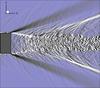
Supersonic axisymmetric wakes
Richard Sandberg (Investigator)
Direct numerical simulations are used to shed more light on structure formation and evolution in supersonic wakes.
Sustainable domain-specific software generation tools for extremely parallel particle-based simulations
Chris-Kriton Skylaris (Investigator)
A range of particle based methods (PBM) are currently used to simulate materials in chemistry, engineering, physics and biophysics. The 4 types of PBM considered directly in the proposed are molecular dynamics (MD), the ONETEP quantum mechanics-based program, discrete element modelling (DEM), and smoothed particle hydrodynamics (SPH).
The overall research objective is to develop a sustainable tool that will deliver, in the future, cutting edge research applicable to applications ranging from dam engineering to atomistic drug design.
The effect of roughness upon turbulent supersonic flows
Neil Sandham (Investigator), Christopher Tyson
Understanding the interaction between surface roughness and supersonic air flows are crucial in the design of high speed vehicles, including space re-entry vehicles. Numerical simulations of these flows has been conducted in order to examine and understand how the surface roughness interacts with high speed flows in terms of drag prediction and heat transfer to the wall surface.
The ONETEP project
Chris-Kriton Skylaris (Investigator), Stephen Fox, Chris Pittock, Álvaro Ruiz-Serrano, Jacek Dziedzic
Program for large-scale quantum mechanical simulations of matter from first principles quantum mechanics. Based on theory and algorithms we have developed for linear-scaling density functional theory calculations on parallel computers.

Transition to turbulence in high-speed boundary layers
Neil Sandham (Investigator), Nicola De Tullio
This work is focused on the numerical simulation of hypersonic transition to turbulence in boundary layers. We use direct numerical simulations of the Navier-Stokes equations to analyse the effects of different flow conditions and external disturbances on the transition process. The main objective is to gain insight into the different aspects of transition to turbulence at high speeds, which can lead to the design of new transition models and transition control techniques for high-speed flows.
People
 Seth Bullock
Professor, Electronics and Computer Science (FPAS)
 Jonathan Essex
Professor, Chemistry (FNES)
 Hans Fangohr
Professor, Engineering Sciences (FEE)
 Richard Sandberg
Professor, Engineering Sciences (FEE)
 Neil Sandham
Professor, Engineering Sciences (FEE)
 John Shrimpton
Professor, Engineering Sciences (FEE)
 Edward Richardson
Senior Lecturer, Engineering Sciences (FEE)
 Gwenael Gabard
Lecturer, Institute of Sound & Vibration Research (FEE)
 Denis Kramer
Lecturer, Engineering Sciences (FEE)
 Kevin Oliver
Lecturer, National Oceanography Centre (FNES)
 Chris-Kriton Skylaris
Lecturer, Chemistry (FNES)
 Anatoliy Vorobev
Lecturer, Engineering Sciences (FEE)
 Syma Khalid
Principal Research Fellow, Chemistry (FNES)
Felipe Alves PortelaResearch Fellow, Engineering Sciences (FEE)
Dirk BroemmelResearch Fellow, Physics & Astronomy (FPAS)
Nicola De TullioResearch Fellow, Engineering Sciences (FEE)
 Aleksander Dubas
Research Fellow, Engineering Sciences (FEE)
 Jacek Dziedzic
Research Fellow, Chemistry (FNES)
 Gabriel Amine-Eddine
Postgraduate Research Student, Engineering Sciences (FEE)
 Jordi Arranz
Postgraduate Research Student, Electronics and Computer Science (FPAS)
 Patrick Bechlars
Postgraduate Research Student, Engineering Sciences (FEE)
 Jamie Caldwell
Postgraduate Research Student, Engineering Sciences (FEE)
 Nicola De Tullio
Postgraduate Research Student, Engineering Sciences (FEE)
Stephen FoxPostgraduate Research Student, Chemistry (FNES)
Aditya KarnikPostgraduate Research Student, Engineering Sciences (FEE)
 Justin Lovegrove
Postgraduate Research Student, Mathematics (FSHS)
 Sam Mangham
Postgraduate Research Student, Electronics and Computer Science (FPAS)
Richard PichlerPostgraduate Research Student, Civil Engineering & the Environment (FEE)
 Chris Pittock
Postgraduate Research Student, Chemistry (FNES)
Watchapon RojanaratanangkulePostgraduate Research Student, Engineering Sciences (FEE)
 Álvaro Ruiz-Serrano
Postgraduate Research Student, Chemistry (FNES)
 Stefan C. Schlanderer
Postgraduate Research Student, Engineering Sciences (FEE)
 Maike Sonnewald
Postgraduate Research Student, National Oceanography Centre (FNES)
Christopher TysonPostgraduate Research Student, Engineering Sciences (FEE)
 Valerio Vitale
Postgraduate Research Student, Electronics and Computer Science (FPAS)
Jess JonesTechnical Staff, iSolutions
 Elena Vataga
Technical Staff, iSolutions
 Petrina Butler
Administrative Staff, Research and Innovation Services
Anurag AgarwalAlumnus, Institute of Sound & Vibration Research (FEE)
 Li-Wei Chen
Alumnus, Osney Thermo-Fluids Laboratory, Oxford University
 Samuel Sinayoko
Alumnus, BMLL
 Ian Bush
External Member, NAG Ltd, Oxford
 Mark Vousden
External Member, University of Southampton
John LeggettNone, None
Markus WeinmannNone, None