Astrophysics
Astrophysics is broadly characterized as the physics of non-terrestrial objects. This could include small objects in our solar system or, through cosmology, the study of the entire universe. At present most projects here study extreme astronomical objects such as black holes, neutron stars and accretion disks.
For queries about this topic, contact Ian Hawke.
View the calendar of events relating to this topic.
Projects

Centre for Doctoral Training in Next Generation Computational Modelling
Hans Fangohr, Ian Hawke, Peter Horak (Investigators), Susanne Ufermann Fangohr, Thorsten Wittemeier, Kieran Selvon, Alvaro Perez-Diaz, David Lusher, Ashley Setter, Emanuele Zappia, Hossam Ragheb, Ryan Pepper, Stephen Gow, Jan Kamenik, Paul Chambers, Robert Entwistle, Rory Brown, Joshua Greenhalgh, James Harrison, Jonathon Waters, Ioannis Begleris, Craig Rafter
The £10million Centre for Doctoral Training was launched in November 2013 and is jointly funded by EPSRC, the University of Southampton, and its partners.
The NGCM brings together world-class simulation modelling research activities from across the University of Southampton and hosts a 4-year doctoral training programme that is the first of its kind in the UK.
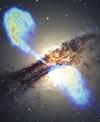
Cosmological evolution of supermassive black holes in the centres of galaxies
Anna Kapinska (Investigator)
Radio galaxies and quasars are among the largest and most powerful single objects known and are believed to have had a significant impact on the evolving Universe and its large-scale structure. Their jets inject a significant amount of energy into the surrounding medium, hence they can provide useful information in the study of the density and evolution of the intergalactic and intracluster medium. The jet activity is also believed to regulate the growth of massive galaxies via the AGN feedback. In this project, through the use of numerical simulations, I explore the intrinsic and extrinsic physical properties of the population of Fanaroff-Riley II (FR II) objects, i.e. their kinetic luminosities, lifetimes, and central densities of their environments. This allows one to investigate evolution of these radio sources across cosmic time, and to discuss the significance of the impact of these sources on the evolving Universe.
Gravitational waves from neutron stars
Ian Hawke (Investigator)
Gravitational waves, once detected, will give information about the extremes of space and time. Compact objects such as neutron stars are perfect locations for generating such waves.
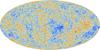
Lattice Holographic Cosmology
Andreas Juttner (Investigator), Matthew Mostert
This project will aim to develop new theoretical field methods and massively parallel computational algorithms to be utilised on both new computational architectures (e.g. Intel Xeon Phi) and existing high performance computers (HPCs).
The ultimate goal is to make predictions for the power spectrum and non-gaussianties of the CMB which would then be falsifiable by comparison to the Planck and WMAP data.
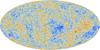
Lattice Holographic Cosmology
This project will aim to develop new theoretical field methods and massively parallel computational algorithms to be utilised on both new computational architectures (e.g. Intel Xeon Phi) and existing high performance computers (HPCs).
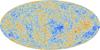
Lattice Holographic Cosmology
This project will aim to develop new theoretical field methods and massively parallel computational algorithms to be utilised on both new computational architectures (e.g. Intel Xeon Phi) and existing high performance computers (HPCs).
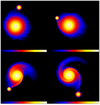
Modelling of neutron star interactions in X-ray binary systems
Malcolm Coe (Investigator), Rory Brown
Investigating the X-ray production mechanisms of binaries containing neutron stars and the decretion disks of Be stars using Smoothed Particle Hydrodynamics (SPH).
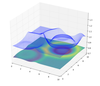
Multiscale modelling of neutron star oceans
Ian Hawke (Investigator), Alice Harpole
Type I X-ray bursts are explosions which occur on the surface of some
neutron stars. It is believed that the burning begins in a localised spot in the ocean of the
star before spreading across the entire surface. By gaining a better understanding of X-ray
bursts, it is hoped that tighter limits can be determined for other neutron star properties
such as the radius and magnetic field strength.
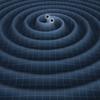
Multiscale Relativistic Simulations
Ian Hawke (Investigator), Alex Wright
There has been recent success in experiments, such as LIGO, in detecting the mergers of celestial objects via the gravitational waves they emit. By implementing numerical methods, we aim to speed up the numerical simulations of these events but up to two orders of magnitudes, and study binary inspirals in greater detail and over much larger timespans.
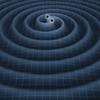
Multiscale Relativistic Simulations
There has been recent success in experiments, such as LIGO, in detecting the mergers of celestial objects via the gravitational waves they emit. I will use numerical methods to simulate the inspiral of a black hole/neutron star binary system.
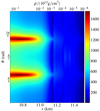
Numerical Elastic Neutron Stars
Ian Hawke, Ian Jones (Investigators), Andrew Penner
We study the astrophysical effects of the crust on a neutron star using an elasto-hydrodynamic model.
Pushing the Envelope of Planetary Formation and Evolution Simulations
Peter Bartram
A full understanding of the formation and the early evolution of the Solar System and extrasolar planetary systems ranks among natural science's grand challenges, and at present, even the dominant processes responsible for generating the observed planetary architecture remain elusive.
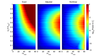
Relativistic multifluids
Ian Hawke (Investigator)
Multiphase flow is a central model in fluid dynamics. Its extension to relativity is crucial for tackling many astrophysics problems, and has fascinating mathematical features.
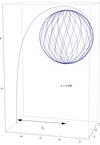
Self-Force and Black Hole Inspirals
Sam Dolan (Investigator)
We use IRIDIS to compute the self-force acting on a solar-mass black hole orbiting a supermassive black hole.
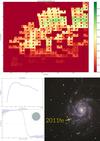
Supernova Rates in the Local Universe
Mark Sullivan (Investigator), Christopher Frohmaier
This project will calculate the frequency of exploding stars -- or supernovae -- in the nearby universe. We simulate a 'toy universe' by exploding billions of stars in a computer, and then artificially 'observing' these explosions by replicating a real astronomical sky survey, the Palomar Transient Factory (PTF). The results of this simulation allows us to discover the rate at which supernovae occur in the local universe each year.
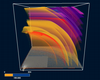
Whisky Code
Ian Hawke (Investigator)
A 3D finite volume code for simulating compact relativistic hydrodynamics.
People
 Malcolm Coe
Professor, Physics & Astronomy (FPAS)
 Hans Fangohr
Professor, Engineering Sciences (FEE)
 Carsten Gundlach
Professor, Mathematics (FSHS)
 Peter Horak
Reader, Optoelectronics Research Centre
Andreas JuttnerReader, Physics & Astronomy (FPAS)
 Gwenael Gabard
Lecturer, Institute of Sound & Vibration Research (FEE)
 Ian Hawke
Lecturer, Mathematics (FSHS)
 Ian Jones
Lecturer, Mathematics (FSHS)
Mark SullivanPrincipal Research Fellow, Physics & Astronomy (FPAS)
 Sam Dolan
Research Fellow, Mathematics (FSHS)
Peter BartramPostgraduate Research Student, University of Southampton
 Ioannis Begleris
Postgraduate Research Student, Engineering Sciences (FEE)
 Rory Brown
Postgraduate Research Student, Civil Engineering & the Environment (FEE)
 Paul Chambers
Postgraduate Research Student, Engineering Sciences (FEE)
 Samuel Diserens
Postgraduate Research Student, Engineering Sciences (FEE)
Caroline DuignanPostgraduate Research Student, Biological Sciences (FNES)
 Robert Entwistle
Postgraduate Research Student, Engineering Sciences (FEE)
 Christopher Frohmaier
Postgraduate Research Student, Physics & Astronomy (FPAS)
 Stephen Gow
Postgraduate Research Student, Engineering Sciences (FEE)
 Joshua Greenhalgh
Postgraduate Research Student, Engineering Sciences (FEE)
 Alice Harpole
Postgraduate Research Student, Mathematics (FSHS)
 James Harrison
Postgraduate Research Student, Engineering Sciences (FEE)
 Tim Lemon
Postgraduate Research Student, Mathematics (FSHS)
 Justin Lovegrove
Postgraduate Research Student, Mathematics (FSHS)
 David Lusher
Postgraduate Research Student, Engineering Sciences (FEE)
 Sam Mangham
Postgraduate Research Student, Electronics and Computer Science (FPAS)
 Matthew Mostert
Postgraduate Research Student, Engineering Sciences (FEE)
 Alvaro Perez-Diaz
Postgraduate Research Student, Engineering Sciences (FEE)
 Craig Rafter
Postgraduate Research Student, Engineering Sciences (FEE)
 Hossam Ragheb
Postgraduate Research Student, Engineering Sciences (FEE)
 Kieran Selvon
Postgraduate Research Student, Engineering Sciences (FEE)
 Ashley Setter
Postgraduate Research Student, Engineering Sciences (FEE)
 Jonathon Waters
Postgraduate Research Student, Engineering Sciences (FEE)
 Thorsten Wittemeier
Postgraduate Research Student, Engineering Sciences (FEE)
 Alex Wright
Postgraduate Research Student, Civil Engineering & the Environment (FEE)
 Emanuele Zappia
Postgraduate Research Student, Engineering Sciences (FEE)
 Elena Vataga
Technical Staff, iSolutions
 Petrina Butler
Administrative Staff, Research and Innovation Services
 Susanne Ufermann Fangohr
Administrative Staff, Civil Engineering & the Environment (FEE)
 Jan Kamenik
Alumnus, University of Southampton
Anna KapinskaAlumnus, ICG, University of Portsmouth
John MuddleAlumnus, Mathematics (FSHS)
Andrew PennerAlumnus, Mathematics (FSHS)
Satya JammyNone, None