Structural dynamics
For queries about this topic, contact Atul Bhaskar.
View the calendar of events relating to this topic.
Projects
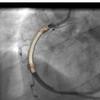
Coronary Artery Stent Design for Challenging Disease
Neil Bressloff (Investigator), Georgios Ragkousis
In this work, a method has been setup to (i) reconstruct diseased patient specific coronary artery segments; (ii) use the new supercomputer to run many simulations of this complex problem and (iii) assess the degree of stent malapposition. The aim now is to devise a stent delivery system that can mitigate this problem
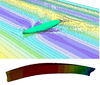
Coupled Fluid-Structure Interaction to model Three-Dimensional Dynamic Behaviour of Ships in Waves
Pandeli Temarel, Zhi-Min Chen (Investigators), Puram Lakshmynarayanana
In the present study we focus our attention on fluid-structure interactions (FSI) of flexible marine structures in waves by coupling a fluid solver using Computational Fluid Dynamics (CFD) and a structural solver using Finite Element Analysis (FEA) software.
Development of wide-ranging functionality in ONETEP
Chris-Kriton Skylaris (Investigator), Jacek Dziedzic
ONETEP is at the cutting edge of developments in first principles calculations. However, while the fundamental difficulties of performing accurate first-principles calculations with linear-scaling cost have been solved, only a small core of functionality is currently available in ONETEP which prevents its wide application. In this collaborative project between three Universities, the original developers of ONETEP will lead an ambitious workplan whereby the functionality of the code will be rapidly and significantly enriched.
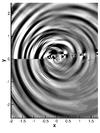
Effects of trailing edge elasticity on trailing edge noise
Richard Sandberg (Investigator), Stefan C. Schlanderer
This work considers the effect of trailing edge elasticity on the acoustic and hydrodynamic field of a trailing edge flow. To that end direct numerical simulations that are fully coupled to a structural solver are conducted.

Evaluation of Vortex Shedding effects on Slender Structures using Large-Eddy Simulation
Zheng-Tong Xie, Ian Castro (Investigators), Steven Daniels
Wind-induced vortex shedding on buildings is a main concern for the engineer, as this can lead to severe structural failures, or at the very least fatigue concerns. Wind tunnel testing of this effect is somewhat limited with the generation of turbulent flow, making the use of numerical techniques more appealing. Using Iridis3&4, Computational Fluid Dynamics has been employed to simulate the turbulent wind flow around tall buildings and bridge decks. The research proposes novel numerical techniques for the analysis of vortex induced effects on these structures for an effective use in industry.
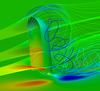
Fluid Structure Interactions of Yacht Sails
Stephen Turnock (Investigator), Daniele Trimarchi
The research is the main subject of the PhD topic. It regards the application of fluid structure interaction techniques to the domain of yacht sails simulation
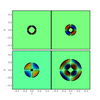
High-resolution shock-capturing (HRSC) methods for elastic matter in general relativity
Carsten Gundlach, Ian Hawke, Stephanie Erickson (Investigators)
We are designing HRSC methods for numerical simulation of elastic matter coupled to general relativity and later magnetic fields, with the ultimate aim of simulating old neutron stars, which have elastic crusts.
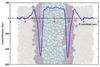
How far can we stretch the MARTINI?
Syma Khalid (Investigator), Ric Gillams
To date, coarse-grained lipid models have generally been parameterised to ensure the correct prediction of structural properties of membranes, such as the area per lipid and the bilayer thickness. The work described here explores the extent to which coarse-grained models are able to predict correctly bulk properties of lipids (phase behaviour) as well as the mechanical properties, such as lateral pressure profiles and stored elastic stress in bilayers. Such an evaluation is crucial for understanding the predictive capabilities of coarse-grained models.
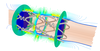
Multi-objective design optimisation of coronary stents
Neil Bressloff, Georges Limbert (Investigators), Sanjay Pant
Stents are tubular type scaffolds that are deployed (using an inflatable balloon on a catheter), most commonly to recover the shape of narrowed (diseased) arterial segments. Despite the widespread clinical use of stents in cardiovascular intervention, the presence of such devices can cause adverse responses leading to fatality or to the need for further treatment. The most common unwanted responses of inflammation are in-stent restenosis and thrombosis. Such adverse biological responses in a stented artery are influenced by many factors, including the design of the stent. This project aims at using multi-objective optimisation techniques to find an optimum family of coronary stents which are more resistant to the processes of in-stent restenosis (IR) and stent thrombosis (ST).
Sustainable domain-specific software generation tools for extremely parallel particle-based simulations
Chris-Kriton Skylaris (Investigator)
A range of particle based methods (PBM) are currently used to simulate materials in chemistry, engineering, physics and biophysics. The 4 types of PBM considered directly in the proposed are molecular dynamics (MD), the ONETEP quantum mechanics-based program, discrete element modelling (DEM), and smoothed particle hydrodynamics (SPH).
The overall research objective is to develop a sustainable tool that will deliver, in the future, cutting edge research applicable to applications ranging from dam engineering to atomistic drug design.
The ONETEP project
Chris-Kriton Skylaris (Investigator), Stephen Fox, Chris Pittock, Álvaro Ruiz-Serrano, Jacek Dziedzic
Program for large-scale quantum mechanical simulations of matter from first principles quantum mechanics. Based on theory and algorithms we have developed for linear-scaling density functional theory calculations on parallel computers.
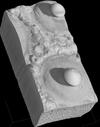
µ-VIS Computed Tomography Centre
Ian Sinclair, Richard Boardman, Dmitry Grinev, Philipp Thurner, Simon Cox, Jeremy Frey, Mark Spearing, Kenji Takeda (Investigators)
A dedicated centre for computed tomography (CT) at Southampton, providing complete support for 3D imaging science, serving Engineering, Biomedical, Environmental and Archaeological Sciences. The centre encompasses five complementary scanning systems supporting resolutions down to 200nm and imaging volumes in excess of one metre: from a matchstick to a tree trunk, from an ant's wing to a gas turbine blade.
People
 Neil Bressloff
Professor, Engineering Sciences (FEE)
 Simon Cox
Professor, Engineering Sciences (FEE)
 Jeremy Frey
Professor, Chemistry (FNES)
 Carsten Gundlach
Professor, Mathematics (FSHS)
 Richard Sandberg
Professor, Engineering Sciences (FEE)
 Ian Sinclair
Professor, Engineering Sciences (FEE)
 Mark Spearing
Professor, Engineering Sciences (FEE)
Pandeli TemarelProfessor, Civil Engineering & the Environment (FEE)
 Stephen Turnock
Professor, Engineering Sciences (FEE)
 Zheng-Tong Xie
Professor, Engineering Sciences (FEE)
 Tiina Roose
Reader, Engineering Sciences (FEE)
 Prasanth Nair
Senior Lecturer, Engineering Sciences (FEE)
Zhi-Min ChenLecturer, Chemistry (FNES)
 Gwenael Gabard
Lecturer, Institute of Sound & Vibration Research (FEE)
 Ian Hawke
Lecturer, Mathematics (FSHS)
 Georges Limbert
Lecturer, Engineering Sciences (FEE)
Marcus NewtonLecturer, Physics & Astronomy (FPAS)
 Chris-Kriton Skylaris
Lecturer, Chemistry (FNES)
 Philipp Thurner
Lecturer, Engineering Sciences (FEE)
 Syma Khalid
Principal Research Fellow, Chemistry (FNES)
 Richard Boardman
Senior Research Fellow, Engineering Sciences (FEE)
Rie SugimotoSenior Research Fellow, Institute of Sound & Vibration Research (FEE)
 Philip Williamson
Senior Research Fellow, Biological Sciences (FNES)
 Jacek Dziedzic
Research Fellow, Chemistry (FNES)
Dmitry GrinevResearch Fellow, Engineering Sciences (FEE)
 Joseph Abram
Postgraduate Research Student, Electronics and Computer Science (FPAS)
 Steven Daniels
Postgraduate Research Student, Engineering Sciences (FEE)
 Stephanie Erickson
Postgraduate Research Student, Mathematics (FSHS)
Stephen FoxPostgraduate Research Student, Chemistry (FNES)
 Ric Gillams
Postgraduate Research Student, Chemistry (FNES)
Puram LakshmynarayananaPostgraduate Research Student, Civil Engineering & the Environment (FEE)
 Juraj Mihalik
Postgraduate Research Student, Engineering Sciences (FEE)
Sanjay PantPostgraduate Research Student, Engineering Sciences (FEE)
 Chris Pittock
Postgraduate Research Student, Chemistry (FNES)
 Hossam Ragheb
Postgraduate Research Student, Engineering Sciences (FEE)
 Georgios Ragkousis
Postgraduate Research Student, Engineering Sciences (FEE)
 Álvaro Ruiz-Serrano
Postgraduate Research Student, Chemistry (FNES)
 Stefan C. Schlanderer
Postgraduate Research Student, Engineering Sciences (FEE)
 Daniele Trimarchi
Postgraduate Research Student, Engineering Sciences (FEE)
 Petrina Butler
Administrative Staff, Research and Innovation Services
 Kenji Takeda
Alumnus, Engineering Sciences (FEE)
 Mark Vousden
External Member, University of Southampton
Ian CastroNone, None