Vortices in Spinor Bose-Einstein Condensates
- Started
- 14th July 2009
- Research Team
- Justin Lovegrove
- Investigators
- Janne Ruostekoski
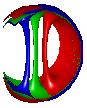
Density isosurfaces for three spin components in a vortex system. The density minima are in different places and so the total density is never zero.
When an atomic gas is cooled to near absolute zero, it forms an atomic superfluid - a fluid which flows without friction or viscosity. These superfluids are of particular interest as they exhibit quantum-mechanical phenomena on observable size scales, whereas quantum behaviours are usually restricted to distances so small as to be impossible to observe with current technology. One result of this is the formation of quantised vortices. These are analogous to vortices in normal fluids, such as when you pull the plug out of a bathtub. However, while a normal fluid vortex will dissipate over time, a quantised vortex continues flowing forever. This can be understood in terms of topology, a branch of pure mathematics describing different types of singularities. Including different symmetries in the system, such as atomic spin, changes the topology and so enables different types of vortices to emerge. When the atomic spin is forced to align with an applied magnetic field, the vortex cores form lines of zero density. One of the outcomes of this project has been to show that when the atomic spins are free to re-orient, the vortex cores can fill with atoms.
To study these systems we numerically solve coupled, nonlinear differential equations in 3+1 dimensions, requiring up to 256^3 spatial grid points and 10^7 iterations in time. With Iridis, we are able to run many such simulations in parallel, enabling us to study vortices over a wide parameter space. This allows us to identify which vortices can be found under various experimental conditions, enabling a probe of quantum physics in the laboratory.
The value of these vortices is not limited to the fact that they are quantum objects. Their nature as topological defects can also aid research across a wide range of fields. Systems with the same topology display the same types of defects and so by experimentally studying quantised vortices, it is possible to probe, by analogy, defects arising in other fields. For example, topological defects are predicted to have formed during phase transitions in the early universe as well as appearing in quantum field theory - neither of which can be studied in current experiments. By creating atomic systems with the same topology, it is possible to experimentally study the predicted topological defects from these extreme physical scenarios.
Categories
Physical Systems and Engineering simulation: Superfluidity
Algorithms and computational methods: FFT, Multi-core
Programming languages and libraries: Fortran, Matlab, OpenMP