PETSc

PETSc (the Portable, Extensible Toolkit for Scientific Computation) is an open source library for scientific computations written in C. It provides a generic framework to manipulate vectors and sparse or dense matrices, solve linear systems, etc. It offers a unified interface to a variety of different algorithms and implementations. In other words, a unique interface is provided as a frontend for different algorithms which can be selected either adding a switch to the command line or by calling an appropriate function. PETSc is built on top of BLAS/LAPACK and MPI to offer high performance and parallelisation capabilities. It comes with built-in monitoring tools to understand and remove the inefficiencies in the user's high performance computing code. Features include: parallel vectors, parallel matrices, several sparse storage formats easy, scalable parallel preconditioners, Krylov subspace methods, parallel Newton-based nonlinear solvers, parallel timestepping (ODE) solvers, support for Nvidia GPU cards, complete documentation, automatic profiling of floating point and memory usage, consistent user interface, intensive error checking, portable to UNIX and Windows, over one hundred examples. See the website: http://www.mcs.anl.gov/petsc/petsc-as/index.html.
For queries about this topic, contact Hans Fangohr.
View the calendar of events relating to this topic.
Projects
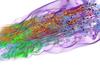
Advanced modelling for two-phase reacting flow
Edward Richardson (Investigator)
Engine designers want computer programs to help them invent ways to use less fuel and produce less pollution. This research aims to provide an accurate and practical model for the injection and combustion of liquid fuel blends.
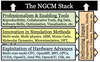
Centre for Doctoral Training in Next Generation Computational Modelling
Hans Fangohr, Ian Hawke, Peter Horak (Investigators), Susanne Ufermann Fangohr, Thorsten Wittemeier, Kieran Selvon, Alvaro Perez-Diaz, David Lusher, Ashley Setter, Emanuele Zappia, Hossam Ragheb, Ryan Pepper, Stephen Gow, Jan Kamenik, Paul Chambers, Robert Entwistle, Rory Brown, Joshua Greenhalgh, James Harrison, Jonathon Waters, Ioannis Begleris, Craig Rafter
The £10million Centre for Doctoral Training was launched in November 2013 and is jointly funded by EPSRC, the University of Southampton, and its partners.
The NGCM brings together world-class simulation modelling research activities from across the University of Southampton and hosts a 4-year doctoral training programme that is the first of its kind in the UK.
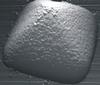
Designer 3D Magnetic Mesostructures
Hans Fangohr (Investigator), Matteo Franchin, Andreas Knittel
A new electrodeposition self-assembly method allows for the growth of well defined mesostructures. This project's aim is to use this method in order to fabricate supraconducting and ferromagnetic mesostructures. Numerical methods based on well-established models are used in order to characterise the grown structures.
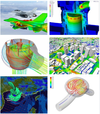
Massively-Parallel Computational Fluid Dynamics
Simon Cox, Stephen Turnock, Alexander Phillips (Investigators), James Hawkes
Computational Fluid Dynamics (CFD) is a numerical method for modelling fluid flows and heat transfer - and is used in many industries. It can be used to model dynamics around aircraft, ships and land vehicles; and also has uses in engine design, architecture, weather forecasting, medicine, computer-generated imagery (CGI) and much more. To harness the full power of CFD, it is necessary to utilise the full power of modern supercomputers. This project aims to improve the scalabilty of existing CFD codes so that more complex problems can be tackled efficiently.
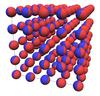
Modelling micromagnetism at elevated temperature
Hans Fangohr, Kees de Groot, Peter de_Groot (Investigators), Dmitri Chernyshenko
We aim to develop a multiscale multiphysics model of
micromagnetism at elevated temperatures with atomistic simulations for
material parameter. The tool will be used to guide the development of the next generation magnetic data storage technology: heat assisted magnetic recording.
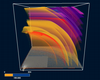
Whisky Code
Ian Hawke (Investigator)
A 3D finite volume code for simulating compact relativistic hydrodynamics.
People
 Simon Cox
Professor, Engineering Sciences (FEE)
 Kees de Groot
Professor, Electronics and Computer Science (FPAS)
 Hans Fangohr
Professor, Engineering Sciences (FEE)
 Stephen Turnock
Professor, Engineering Sciences (FEE)
 Peter Horak
Reader, Optoelectronics Research Centre
 Tobias Keller
Reader, Ocean & Earth Science (FNES)
 Prasanth Nair
Senior Lecturer, Engineering Sciences (FEE)
 Edward Richardson
Senior Lecturer, Engineering Sciences (FEE)
 Ian Hawke
Lecturer, Mathematics (FSHS)
Felipe Alves PortelaResearch Fellow, Engineering Sciences (FEE)
Petros BogiatzisResearch Fellow, Ocean & Earth Science (FNES)
 Ioannis Begleris
Postgraduate Research Student, Engineering Sciences (FEE)
 Rory Brown
Postgraduate Research Student, Civil Engineering & the Environment (FEE)
 Paul Chambers
Postgraduate Research Student, Engineering Sciences (FEE)
 Robert Entwistle
Postgraduate Research Student, Engineering Sciences (FEE)
 Stephen Gow
Postgraduate Research Student, Engineering Sciences (FEE)
 Joshua Greenhalgh
Postgraduate Research Student, Engineering Sciences (FEE)
 James Harrison
Postgraduate Research Student, Engineering Sciences (FEE)
 James Hawkes
Postgraduate Research Student, Engineering Sciences (FEE)
 David Lusher
Postgraduate Research Student, Engineering Sciences (FEE)
 Alvaro Perez-Diaz
Postgraduate Research Student, Engineering Sciences (FEE)
 Craig Rafter
Postgraduate Research Student, Engineering Sciences (FEE)
 Hossam Ragheb
Postgraduate Research Student, Engineering Sciences (FEE)
 Kieran Selvon
Postgraduate Research Student, Engineering Sciences (FEE)
 Ashley Setter
Postgraduate Research Student, Engineering Sciences (FEE)
 Jonathon Waters
Postgraduate Research Student, Engineering Sciences (FEE)
 Thorsten Wittemeier
Postgraduate Research Student, Engineering Sciences (FEE)
 Emanuele Zappia
Postgraduate Research Student, Engineering Sciences (FEE)
 Petrina Butler
Administrative Staff, Research and Innovation Services
 Susanne Ufermann Fangohr
Administrative Staff, Civil Engineering & the Environment (FEE)
 Peter de_Groot
Alumnus, Physics & Astronomy (FPAS)
 Matteo Franchin
Alumnus, Engineering Sciences (FEE)
 Jan Kamenik
Alumnus, University of Southampton
 Andreas Knittel
Alumnus, Industry
 Weiwei Wang
Alumnus, Ningbo University
 Marijan Beg
External Member, Imperial College London
Alexander PhillipsNone, None