Computational Modelling Group

Iain Weaver

Position
Postgraduate Research Student
Institution
Electronics and Computer Science (FPAS)
E-mail
isw1g10@soton.ac.uk
Contact
Complete this online contact form to contact Iain.

1st Year PhD
My research interests are focussed around self-organisation of systems of many interacting components as viewed through the lens of thermodynamics and statistical physics more generally.

The vast majority of naturally occurring systems exist far from equilibrium, where they may exploit energy density gradients to self-organise, in turn modifying the gradient. I believe that the interplay and co-evolution of components and the energy gradient they are subjected to to be the general ingredients for the emergence of complexity.

To gain an understanding of these complex dissipative systems of many degrees of freedom, I approach from the ground up, reformulating existing conceptual models not only in a simple terms as possible, but with emphasis on identifying, and analysing the relevant energy gradient and it's co-evolution with system components.

1st Year IRP
Preferential attachment in Randomly Grown Networks
We introduce a model of undirected network growth where vertices and edges are introduced at a constant rates of 1 and δ respectively. The ends of new edges are allowed to connect to vertices with different preferences for high degree vertices denoted by model parameters m1 and m2. We verify that m1, m2 → ∞ is the special case of Callaway et al. where edges connect randomly without preference, and that finite m1 or m2 produce power-law degree distributions. With the addition of even weak preferential attachment, the qualitative behaviour of the emerging giant component is unchanged, while we find preferential attachment alone to eliminate the discontinuity in component sizes across the phase transition. Furthermore, we find the randomly grown case to be special in that for any finite m1 or m2, positive degree correlation is lost with increasing δ.

1st Year Dissertation
Maximum Entropy Production Principle at Work in Period-Halving of Rayleigh-Bénard Convection Cells
Self-organisation is a hallmark of complex systems whereby microscopic interactions induce symmetry breaking, evident in macroscopic observations of structure, and a range of phenomena such as hysteresis. Such spontaneous organisation is abundant in natural, non-equilibrium systems where structures form in order to dissipate energy gradients. The co-evolution of the system and energy gradient is poorly understood; there exists no generally applicable principle to explain such self-organised dissipative structures. We investigate the properties of one such structure, Rayleigh-Bénard convection cells, where convection represents a non-equilibrium structure produced across a temperature gradient, and test the applicability of the maximum entropy production principle in predicting the scales of emerging convection cells.

We implement and modify a simple two-dimensional FHP-I lattice gas to produce Rayleigh-Bénard convection. This is then translated into a lattice Boltzmann model to allow for hugely more efficient investigation of entropy production in a range of steady-state convection cell arrangements. We attempt to make the distinction between maximum dissipation and maximum entropy production by relaxing the assumption of constant temperature at the hot and cold reservoirs. By examining the stability and entropy production of a range of convective states, we find the most stable period is that which maximises vertical heat flux, although we are unable to disambiguate maximisation of heat flux and entropy production. Still, this work supports the existence of such extremum principles in allowing us to determine complex macroscopic structures from this simple extremum principle.

Research Groups

Gallery

1st Year Dissertation (2):
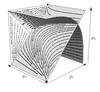
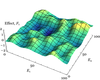
Entropy production rates corresponding to a range of convection cell periods over a range of cavity sizes.

1st Year Dissertation (1):
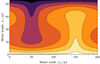
Lattice-Boltzmann model of convection cells on a 2D FHP-I lattice.

1st Year IRP (2)
Edge degree distribution is analytically tractable, and finds increasing degree skew for strong preferential attachment.

1st Year IRP (1)
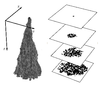
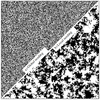
Visualisations of networks with a range of edge end preferential attachment. Images show
(top) no preference
(middle) one end preferential, one end random
(bottom) both ends prefential

1st Year Dissertation (3):
Entropic hysteresis loops formed by transitions to more stable, higher entropy production convection periods.