QCD
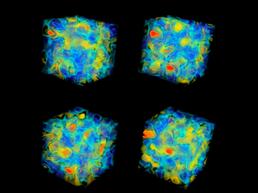
Large scale computer simulations of the strong nuclear force, or Quantum Chromodynamics (QCD) allow us to test the Standard Model of particle physics, understand quark confinement, explore extremes of density and temperature and constrain models of new physics. The fundamental constituent quarks and gluons are not seen experimentally. Instead we must understand how the particles we do detect emerge as complicated bound states of the constituents. Computations on a discretised chunk of space-time, the lattice, are the only known way to establish this connection from first principles and can involve the largest national and international HPC facilities. We are part of the RBC-UKQCD collaboration which designed and built special-purpose QCDOC computers for lattice simulations. QCDOC design features were taken up in IBM's BlueGene systems. Members of our collaboration are now working on successor systems in collaboration with IBM.
Case Study: weak matrix elements
The weak interaction can change the identities of quarks, but because of strong interactions between quarks and gluons the fundamental quark interactions lead to decays of bound-state particles into other particles. Lattice QCD simulations can evaluate the strengths of these decays and thereby probe the underlying quark interactions. Calculations of kaon decays to pairs of pions allow us to test CP-violation, the breaking of the combination of particle-antiparticle and mirror reflection symmetry, whose understanding is bound up with the dominance of matter over antimatter in the Universe. Lattice calculations of weak decays involving bottom quarks will be tested with unprecedented precision at the recently-restarted Large Hadron Collider in Geneva and could provide clues to new physics beyond the current Standard Model.
For queries about this topic, contact Jonathan Flynn.
View the calendar of events relating to this topic.
Projects

B-meson coupling with relativistic heavy quarks
Jonathan Flynn (Investigator), Ben Samways, Dirk Broemmel, Patrick Fritzsch
We non-perturbatively compute the coupling between B* and B pi meson states relying on relativistic heavy quarks and domain wall light fermions. The coupling is of importance for an effective description of hadronic heavy meson decays.
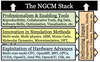
Centre for Doctoral Training in Next Generation Computational Modelling
Hans Fangohr, Ian Hawke, Peter Horak (Investigators), Susanne Ufermann Fangohr, Thorsten Wittemeier, Kieran Selvon, Alvaro Perez-Diaz, David Lusher, Ashley Setter, Emanuele Zappia, Hossam Ragheb, Ryan Pepper, Stephen Gow, Jan Kamenik, Paul Chambers, Robert Entwistle, Rory Brown, Joshua Greenhalgh, James Harrison, Jonathon Waters, Ioannis Begleris, Craig Rafter
The £10million Centre for Doctoral Training was launched in November 2013 and is jointly funded by EPSRC, the University of Southampton, and its partners.
The NGCM brings together world-class simulation modelling research activities from across the University of Southampton and hosts a 4-year doctoral training programme that is the first of its kind in the UK.
Hadronic structure on the computer
Jonathan Flynn (Investigator), Dirk Broemmel, Thomas Rae, Ben Samways
In experiments at the Large Hadron Collider (LHC) at CERN, Geneva, the interactions that occur between the colliding particles (protons in this case) can be factorised into a simple scattering between two constituent particles, called quarks, followed by a hadronisation process, which describes the dynamics of forming the bound proton states. Quarks are particles within the proton that bind to form composite particles (hadrons) such as a proton. The scattering process can be computed relatively easily, but hadronisation is intrinsically non-perturbative and hard to calculate. Lattice QCD (computer simulation of QCD on a discrete space-time lattice) provides our only known first-principles and systematically-improvable method to address problems like hadronisation. This project uses Iridis to extract parton distribution amplitudes which are experimentally inaccessible, but needed to describe the quark structure of hadrons.

Kaon to two pion decays in lattice QCD
Jonathan Flynn (Investigator), Elaine Goode, Dirk Broemmel
We calculate kaon decay amplitudes on the lattice so we may compare the Standard Model to experiment.
Lattice Holographic Cosmology
Andreas Juttner (Investigator), Matthew Mostert
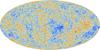
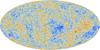
This project will aim to develop new theoretical field methods and massively parallel computational algorithms to be utilised on both new computational architectures (e.g. Intel Xeon Phi) and existing high performance computers (HPCs).
The ultimate goal is to make predictions for the power spectrum and non-gaussianties of the CMB which would then be falsifiable by comparison to the Planck and WMAP data.
Lattice Holographic Cosmology
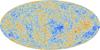
This project will aim to develop new theoretical field methods and massively parallel computational algorithms to be utilised on both new computational architectures (e.g. Intel Xeon Phi) and existing high performance computers (HPCs).
Lattice Holographic Cosmology
This project will aim to develop new theoretical field methods and massively parallel computational algorithms to be utilised on both new computational architectures (e.g. Intel Xeon Phi) and existing high performance computers (HPCs).
Non-Perturbative Renormalisation on the Lattice
Jonathan Flynn (Investigator), Dirk Broemmel, Thomas Rae
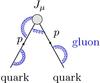
In this project we compute renormalisation factors for various physical observables in a non-perturbative lattice framework. Renormalisation hereby arises due to a fundamental scale dependence of the physical processes.
Precision study of critical slowing down in lattice simulations of the CP^{N-1} model
Jonathan Flynn, Andreas Juttner (Investigators), Andrew Lawson
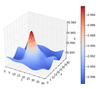
This project involves the study of critical slowing down (CSD): a property that may arise when taking measurements in Monte Carlo simulations. In order to study and quantify this phenomenon we have performed extensive simulations of the CP^{N-1} model. By studying the properties of the Monte Carlo algorithms in this model, we hope to make algorithmic improvements that can then be employed in simulations of physical quantum field theories, such as in lattice quantum chromodynamics (lattice QCD).
pyQCD
Matthew Spraggs
A basic Python package to perform coarse lattice QCD simulations on desktop and workstation computers.
Towards Exascale computing in particle physics
Andreas Juttner, Jonathan Flynn (Investigators), James Harrison
Lattice QCD
People
 Hans Fangohr
Professor, Engineering Sciences (FEE)
 Jonathan Flynn
Professor, Physics & Astronomy (FPAS)
 Peter Horak
Reader, Optoelectronics Research Centre
 Andreas Juttner
Reader, Physics & Astronomy (FPAS)
 Neil Broderick
Lecturer, Optoelectronics Research Centre
 Ian Hawke
Lecturer, Mathematics (FSHS)
Dirk BroemmelResearch Fellow, Physics & Astronomy (FPAS)
 Ioannis Begleris
Postgraduate Research Student, Engineering Sciences (FEE)
 Rory Brown
Postgraduate Research Student, Civil Engineering & the Environment (FEE)
 Paul Chambers
Postgraduate Research Student, Engineering Sciences (FEE)
 Robert Entwistle
Postgraduate Research Student, Engineering Sciences (FEE)
Elaine GoodePostgraduate Research Student, Physics & Astronomy (FPAS)
 Stephen Gow
Postgraduate Research Student, Engineering Sciences (FEE)
 Joshua Greenhalgh
Postgraduate Research Student, Engineering Sciences (FEE)
 James Harrison
Postgraduate Research Student, Engineering Sciences (FEE)
Andrew LawsonPostgraduate Research Student, Physics & Astronomy (FPAS)
 Edwin Lizarazo
Postgraduate Research Student, Physics & Astronomy (FPAS)
 David Lusher
Postgraduate Research Student, Engineering Sciences (FEE)
 Matthew Mostert
Postgraduate Research Student, Engineering Sciences (FEE)
 Alvaro Perez-Diaz
Postgraduate Research Student, Engineering Sciences (FEE)
Thomas RaePostgraduate Research Student, Physics & Astronomy (FPAS)
 Craig Rafter
Postgraduate Research Student, Engineering Sciences (FEE)
 Hossam Ragheb
Postgraduate Research Student, Engineering Sciences (FEE)
 Álvaro Ruiz-Serrano
Postgraduate Research Student, Chemistry (FNES)
 Ben Samways
Postgraduate Research Student, Physics & Astronomy (FPAS)
 Kieran Selvon
Postgraduate Research Student, Engineering Sciences (FEE)
 Ashley Setter
Postgraduate Research Student, Engineering Sciences (FEE)
 Matthew Spraggs
Postgraduate Research Student, Electronics and Computer Science (FPAS)
 Jonathon Waters
Postgraduate Research Student, Engineering Sciences (FEE)
 Thorsten Wittemeier
Postgraduate Research Student, Engineering Sciences (FEE)
 Emanuele Zappia
Postgraduate Research Student, Engineering Sciences (FEE)
 Elena Vataga
Technical Staff, iSolutions
 Petrina Butler
Administrative Staff, Research and Innovation Services
 Susanne Ufermann Fangohr
Administrative Staff, Civil Engineering & the Environment (FEE)
 Jan Kamenik
Alumnus, University of Southampton