Complex Systems
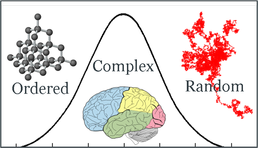
Complexity Science is an attempt to better understand systems in which aggregate, system-level behaviour arises from the interactions between component parts in a way that is not straightforward. Whereas the temperature of an ideal gas is just a simple average over the kinetic energy of its component molecules, the "temperature" of a football crowd or the temperature of the earth do not behave in the same way. Adding some more energy to some of the gas molecules will increase the macroscopic temperature proportionally. By contrast, adding a little more "heat" to a few members of a football crowd can result in a disproportionate, or non-linear, change in behaviour, sometimes bringing about macroscopic surges, songs, and even Mexican waves. This kind of interesting relationship between the individual components of a system and the system's global behaviour is characteristic of many important and intriguing domains: ecosystems, brains, cities, markets, the internet, etc.
The growing significance of understanding and managing such systems means that Complexity Science is increasingly being recognised as a critical area of enquiry by industry, government and science itself.
For more information, click here.
For queries about this topic, contact Seth Bullock.
View the calendar of events relating to this topic.
Projects

A Connected Island: how the Iron Curtain affected Archaeologists in Central Europe
Iza Romanowska
Using citation network analysis this project aims to investigate the effects that the Cold War had on researchers on both sides of the Iron Curtain.
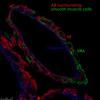
A Mathematical Analysis of the Driving Force of Perivascular Drainage in the Brain
Giles Richardson, Roxana-Octavia Carare (Investigators), Alexandra Diem
The observation that solute drainage in the brain occurs in the reverse direction of the blood flow has for a long time been puzzling for researchers. We developed a simple analytical model that can explain this reverse drainage of solutes and has potential implications for the development of treatment for Alzheimer's Disease.
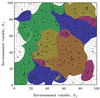
A novel approach to analysing fixed points in complex systems
James Dyke (Investigator), Iain Weaver
This work aims to contribute to our understanding of the relationship between complexity and stability. By describing an abstract coupled life-environment model, we are able to employ novel analytical, and computational techniques to shed light on the properties of such a system.

A novel method for monitoring air pollution from satellites at very high resolution
Joanna Nield, Jason Noble, Edward Milton (Investigators), Robin Wilson
Developing methods to monitor the clarity of the atmosphere from satellites at 100,000 times the resolution of previous methods. This can then be used to monitor air pollution, correct satellite images and provide data for climate studies. Simulation is used to model the effects of atmospheric pollution on light passing through the atmosphere, and to test the method under 'synthetic atmospheres'.
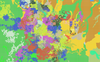
A spatially-explicit agent-based model of jaguar population dynamics
Jason Noble, Patrick Doncaster (Investigators), Angela Watkins
A single species spatially-explicit agent-based model has been developed that illustrates the role of simulation modelling, integrated with an adapted least-cost modelling approach and real-world geographical data, in exploring jaguar population dynamics.
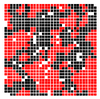
Adding social ties to the Schelling model
Seth Bullock, Sally Brailsford (Investigators), Elisabeth zu-Erbach-Schoenberg
The Schelling model is an abstract model for segregation in
a spatially arranged population. We extended the traditional model by the addition of a dynamic social network. The social network influences the spatial dynamics of agents moving on the grid by changing the agents’ evaluation of their neighbourhood. In turn, the spatial arrangement influences the change of the social network.
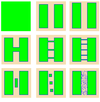
Agent-based simulations of jaguar movements through conservation corridors
Jason Noble, Patrick Doncaster (Investigators), Angela Watkins
We present an agent-based model of jaguars (Panthera onca),
scaled for fragmented habitat in Belize where proposals already exist for creating a jaguar corridor. We use a least cost approach to simulate movement paths through alternative possible landscapes.
Amorphous Computation, Random Graphs and Complex Biological Networks
Seth Bullock (Investigator)
This interdisciplinary research collaboration arose within the Simple Models of Complex Networks research cluster funded by the EPSRC www.epsrca.ac.uk through the Novel Computation Initiative. Here, leading groups from the Universities of Leeds, Sheffield, Nottingham, Southampton, Royal Holloway and King’s College and industrial partners BT are brought together for the first time to develop novel amorphous computation methods based on the theory of random graphs.
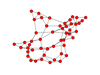
An Evolutionary Economic Approach to the Household?
Jason Hilton
The household is a fundamental societal unit. In a huge array of contexts, our understanding of social behaviour relies on an interpretation of how decision are taken at the household level.This work aims to model individual decision-making and interactions between individuals explicitly within the framework of agent-based modelling, following the work of Potts (2000). Potts describes how economic problems can better be dealt with by considering how agents with incomplete, evolving preferences in the form of decision rules interact on a network, and how they cooperate and form ties to produce combinatorial technologies. Following the work of Gary Becker, he then considers how this ostensibly economic framework might hypothetically describe partnership search and household formation and dissolution.

An investigation in to the effects of information provision on driver learning
Ben Waterson, Hans Fangohr (Investigators), James Snowdon
This work aims to better understand and model the role of individual learning and experience on driver route choice. We intend to demonstrate that vehicle-driver agent based models stand alone in being able to capture the complex reciprocal interactions between drivers and their environment, and allow us to incorporate the effects of prior knowledge from previous trips and advice from official information sources and social networks.

An Investigation into the Cascade Effect of Mergers on the Global Financial Markets
Seth Bullock, Antonella Ianni (Investigators), Camillia Zedan
An investigation into the external effects that horizontal mergers have on the interconnected global markets.
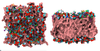
Antimicrobial Peptide and E. coli Membrane Interactions
Syma Khalid (Investigator), Thomas Piggot, Nils Berglund
Antimicrobial peptides (AMPs) are known to disrupt the membranes of bacterial cells such as E. coli. I work on investigating the nature of these interactions using molecular dynamics (MD) simulations.

Associative learning in ecosystems: Network level adaptation as an emergent propery of local selection
Richard Watson, James Dyke (Investigators), Daniel Power
Ecosystems may exhibit collective adaptive properties that arise from natural selection operating on their component species. These properties include the ability of the ecosystem to return to specific configurations of species, in a manner highly analogous to mechanisms of associative learning in neural networks.
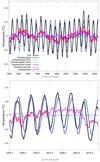
Atlantic ocean meridional heat transport at 26oN: Impact on subtropical ocean heat content variability
Robert Marsh (Investigator), Maike Sonnewald
Local climate is significantly affected by changes in the oceanic heat content on a range of timescales. This variability is driven by heat fluxes from both the atmosphere and the ocean. In the Atlantic the meridional overturning circulation is the main contributor to the oceanic meridional heat transport for latitudes south of about 50? N. The RAPID project has been successfully monitoring the Atlantic meridional overturning at 26? N since 2004. This study demonstrates how this data can be used to estimate the basin-wide ocean heat content in the upper 800 m between 26? N to 36? N. Traditionally the atmosphere is seen to dominate the ocean heat content variability. However, previous studies have looked at smaller areas in the Gulf Stream region, finding that the ocean dominates deseasoned fluctuations of ocean heat content, while studies of the whole North Atlantic region suggest that the atmosphere may be dominant. In our study we use a box-model to investigate fluctuations of the ocean heat content in the subtropical North Atlantic between 26? N and 36? N. The box-model approach is validated using 19 years of high resolution GCM data. We find that in both the GCM and RAPID based data the ocean heat transport dominates the deseasoned heat content variability, while the atmosphere’s impact on the heat content evolution stabilizes after 6 months. We demonstrate that the utility of the RAPID data goes beyond monitoring the overturning circulation at 26? N, and that it can be used to better understand the causes of ocean heat content variability in the North Atlantic. We illustrate this for a recent decrease in ocean heat content which was observed in the North Atlantic in 2009 and 2010. Our results suggest that most of this ocean heat content reduction can be explained by a reduction of the meridional ocean heat transport during this period.
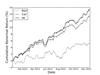
Automated Algorithmic Trading with Intelligent Execution
Frank McGroarty, Enrico Gerding (Investigators), Ash Booth
In this project, we introduce the first fully automated trading system for real-world stock trading that uses time-adaptive execution algorithm to minimise market impact while increasing profitability com- pared to benchmark strategies.
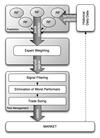
Automated Trading with Performance Weighted Random Forests and Seasonality
Frank McGroarty, Enrico Gerding (Investigators), Ash Booth
This project proposes an expert system that uses novel machine learning techniques to predict the price return over these seasonal events, and then uses these predictions to develop a profitable trading strategy.
Bayesian Agent-Based Population Studies: Transforming Simulation Models of Human Migration
This is a cutting-edge project in demographic methodology, funded by the European Research Council (ERC), through the Consolidator Grant ERC-CoG-2016-725232. Its aim is to develop a ground-breaking simulation model of international migration, based on a population of intelligent, cognitive agents, their social networks and institutions, all interacting with one another. The project also aims to transform the study of migration – one of the most uncertain population processes and a top-priority policy area – by offering a step change in the way it can be understood, predicted, and managed.
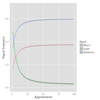
Bayesian Agents as Models for the Disclosure Behaviour of Pregnant Drinkers
Seth Bullock, Jakub Bijak (Investigators), Jonathan Gray
Examining the feasibility of signalling games, played by Bayesian decision theoretic agents as a model for the disclosure of drinking behaviour by pregnant women to their midwives.
Bioclimatic Architecture
Seth Bullock (Investigator), Nicholas Hill
This was a review report on bioclimatic architecture and how such architecture may be designed by agent-based models inspired by the building behaviour of insects.
Body Forces in Particle Suspensions in Turbulence
Gabriel Amine-Eddine (Investigator)
The behaviour of multiphase flows is of primary importance in many engineering applications. In the past, experimental observations have provided many researchers with the ability to understand and probe the phenomena and physical processes occurring in such flows. With advancements in modern day computational power, we now have the ability to gain an even greater wealth of knowledge, from what used to be a physical experiment, is now a virtual simulation.
Amine-Eddine, G.H. (2015) Body forces in particle suspensions in turbulence. University of Southampton, Faculty of Engineering and the Environment, Doctoral Thesis , 283pp.
BRECcIA - Building REsearch Capacity for sustainable water and food security In sub-saharan Africa
The BRECcIA project is aimed at developing research and researchers to understand water and food security challenges in sub-Saharan Africa
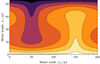
Can the principle of Maximum Entropy Production be used to predict the steady states of a Rayleigh-Bernard convective system?
Kevin Oliver, Iain Weaver, James Dyke (Investigators)
The principle of Maximum Entropy Production (MEP) has been successfully used to reproduce the steady states of a range of non-equilibrium systems. Here we investigate MEP and maximum heat flux extremum principles directly via the simulation of a Rayleigh-Bérnard convective system implemented as a lattice gas model.

Care Life Cycle
Seth Bullock, Sally Brailsford, Jason Noble, Jakub Bijak (Investigators), Elisabeth zu-Erbach-Schoenberg, Jason Hilton, Jonathan Gray
This research programme brings together teams of researchers from social sciences, management science and complexity science to develop a suite of models representing the socio-economic and demographic processes and organisations implicated in the UK’s health and social care provision. Integral to the project is working with our partners in the public sector and communicating the results of these models to policymakers allowing them to effectively plan for the future.
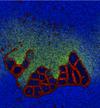
Cellular Automata Modelling of Membrane Formation and Protocell Evolution
Seth Bullock (Investigator), Stuart Bartlett
We simulated the meso-level behaviour of lipid-like particles in a range of chemical and physical environments. Self-organised protocellular structures can be shown to emerge spontaneously in systems with random, homogeneous initial conditions. Introducing an additional 'toxic' particle species and an associated set of synthesis reactions produced a new set of ecological behaviours compared to the original model of Ono and Ikegami.

Centre for Doctoral Training in Next Generation Computational Modelling
Hans Fangohr, Ian Hawke, Peter Horak (Investigators), Susanne Ufermann Fangohr, Thorsten Wittemeier, Kieran Selvon, Alvaro Perez-Diaz, David Lusher, Ashley Setter, Emanuele Zappia, Hossam Ragheb, Ryan Pepper, Stephen Gow, Jan Kamenik, Paul Chambers, Robert Entwistle, Rory Brown, Joshua Greenhalgh, James Harrison, Jonathon Waters, Ioannis Begleris, Craig Rafter
The £10million Centre for Doctoral Training was launched in November 2013 and is jointly funded by EPSRC, the University of Southampton, and its partners.
The NGCM brings together world-class simulation modelling research activities from across the University of Southampton and hosts a 4-year doctoral training programme that is the first of its kind in the UK.
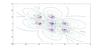
Chaotic Analysis of Partial Discharge
Paul Lewin (Investigator), Lyuboslav Petrov
The deterministic character of PD pulses predicted by theory has been shown to be existent for certain PD events. Finding characteristic patterns in phase space enables field-data PD detection with high reliability.
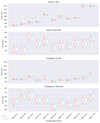
Colonising Polynesia; Uncertain sailing craft route modelling
Thomas Dickson (Investigator), David Sear
Through developing a novel methodology of modelling sailing craft routing it is possible to investigate archaeological problems as well as applications to modern yacht racing and autonomous sailing technology. This research uses iridis to provide accurate and fast analysis of shortest path routes for sailing craft in order to provide insight and improve safety of operation.

Complexity in Modelling Electric Marine Propulsive Devices
Suleiman Sharkh, Neil Bressloff, Hans Fangohr (Investigators), Aleksander Dubas
This project involves the simulation of turbulent flow around a marine rim-driven thruster and the complex interaction of flow features involved through computational fluid dynamics. Following this, the optimisation of design parameters using computational fluid dynamics to calculate the objective function is performed and surrogate modelling utilised to estimate optimum design configuration.

Controlling Ant-Based Construction
Seth Bullock (Investigator), Lenka Pitonakova
This paper investigates dynamics of ant nest building and shows that algorithms capable of generating ant-like structures can also be used to create nests, shapes of which are imposed from outside of the system.

CRISIS – Complexity Research Initiative for Systemic InstabilitieS
Frank McGroarty (Investigator), Bob De Caux
A new approach to modelling and understanding financial system and macroeconomic risk and instability

Design of Unmanned Air Vehicles
James Scanlan (Investigator), Robert Entwistle
Using computational modelling of a 3D airspace simulation environment to meet the safety and collision-avoidance requirements of the certification authorities.
Development of wide-ranging functionality in ONETEP
Chris-Kriton Skylaris (Investigator), Jacek Dziedzic
ONETEP is at the cutting edge of developments in first principles calculations. However, while the fundamental difficulties of performing accurate first-principles calculations with linear-scaling cost have been solved, only a small core of functionality is currently available in ONETEP which prevents its wide application. In this collaborative project between three Universities, the original developers of ONETEP will lead an ambitious workplan whereby the functionality of the code will be rapidly and significantly enriched.
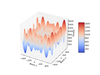
Differences between sexual genetic algorithms and a compositional cooperative co-evolutionary algorithm
Richard Watson (Investigator), Daniel Power
Different algorithms are representative of different genetic processes. This work explores how algorithms representing sexual recombination can solve certain problems that hill climbers cannot.
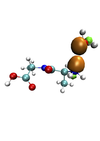
Dipole moment and theoretical spectroscopy: a computational approach
Chris-Kriton Skylaris (Investigator), Valerio Vitale
The present project represents a first step towards the implementation of a new technique to calculate the whole vibrational spectra of molecules in a formally exact way, which fully takes into account anharmonicity and conformational transitions, at a finite temperature, both in gas phase and in solution in a single ab initio molecular dynamics simulation.

Directing magnetic skyrmion traffic flow with nanoscale patterning.
Hans Fangohr (Investigator), Mark Vousden
Skyrmions in magnetic nanostructures may lead to new data storage technologies. Appropriate simulation methodologies are developed and applied.
Do the adaptive dynamics of host-parasite systems catalyse or constrain sympatric speciation?
Richard Watson (Investigator), Daniel Power
Coevolutionary dynamics affect both parties evolutionary trajectories. When might these affect speciation? This project uses a simulation model to explore the issue.

Dual resolution simulations of lipid membrane systems
Jonathan Essex (Investigator), Kieran Selvon
This project aims to shed light on cell membrane mechanisms which are difficult to probe experimentally, in particular drug permiation across the cell membrane. If one had a full understanding of this mechanism, drugs could be designed to easily cross the membrane, or target particular embedded proteins to improve their efficacy. A reliable and robust computational method to asses a molecules permeability would be invaluable in the field of drug design, we seek to perfect such a method.
Dynamics of interacting magnetic nanoparticles
Thomas Fischbacher (Investigator), Maximilian Albert
The project aims at extending the micromagnetic simulation framework 'nmag' developed at the University of Southampton to enable it to handle dynamic geometries. The extended framework will then be used to study systems such as interacting magnetic nanoparticles.
Dynamics simulations for quantum feedback to steer a single-particle harmonic oscillator in non-classical states
Hendrik Ulbricht (Investigator), Ashley Setter
This PhD project is about using digital electronics to implement a parametric feedback loop to modulate the intensity of an optical trapping laser in order to stabilise/cool the centre of mass motion of a nanoparticle. It is then intended we use digital parametric feedback to drive the motion of the particle, which is essentially a quantum harmonic oscillator, into non-classical quantum states such as squeezed and number states.
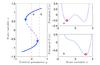
Early warning signals in climate data
Kevin Oliver, James Dyke (Investigators), Maike Sonnewald
Paleoclimatic records reveal that the Earth’s climate system has undergone sharp transitions between
states. Much work has recently been devoted to assessing how likely the current climate is to undergo such a sharp transition. This is motivated by the severe socioeconomic consequences such dramatic changes would entail. Thus, predicting iminent transitions would be very valuable. This review provides an overview of two promising techniques which could potentially be used to assess the stability of components of the climate system. These techniques are degenerate fingerprinting and detrended fluctuation analysis (DFA). It is found that degenerate fingerprinting is more widely used, but that DFA could be more suitable. DFA allows for memory in the time-series, and can give better results with less data. However, the DFA technique is best suited for systems close to the transitions, and relies on calibration with the degenerate fingerprinting technique further from the transition. Applying these techniques to forecast transitions is unfortunately impeded by lack of suitable data. Using data from several sources could overcome this. Thus, the techniques could be very valuable if the use of unevenly spaced data from several sources does
not lead to serious loss off accuracy. However, the techniques are still very useful when assessing underlying dynamics in model output and paleooceanographic time-series.

Evolving Behaviour-Dependent Strategies in Agent Negotiations
Enrico Gerding, Markus Brede (Investigators), Darius Pepe Falahat
We use genetic algorithms to evolve trading strategies for iterative bilateral negotiations between buyers and sellers. In contrast to previous work we evolve purely reactive strategies that base decisions on memories of behaviour in previous negotiation rounds. A paper was written on this research and was published in the proceedings for the European Conference on Artificial Life 2013.

Evolving Resilience to Leverage Based Crashes
Frank McGroarty, Enrico Gerding (Investigators), Ash Booth
This project analyses the maturation, initiation and evolution of crashes in the financial markets using an agent-based model.
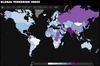
Excitable Boys: An Exploration of the Role of Social Groups in the Self-radicalisation Process Using Agent-based Modelling.
Jason Noble (Investigator), Lewys Brace
This work built upon the seminal work of Sageman (2008), and his hypothesis that the self-radicalisation phenomenon that we are currently witnessing across Europe and the United States stems from self-organising ‘bunches of guys’. More specifically, there was a focus on how individuals can influence one another through social links; and how this can lead to behaviour, similar to deindividuation, arising through their interactions. Complexity theory and agent-based modelling were used in order to explore the interactions that are believed to lie at the heart of this psycho-social phenomenon, and justification is given for this approach. The model presented demonstrated that social bonds can lead to a greater number of individuals ‘rebelling’ against the status quo.
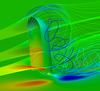
Fluid Structure Interactions of Yacht Sails
Stephen Turnock (Investigator), Daniele Trimarchi
The research is the main subject of the PhD topic. It regards the application of fluid structure interaction techniques to the domain of yacht sails simulation
Fracturing of small social networks
Seth Bullock, Sally Brailsford (Investigators), Elisabeth zu-Erbach-Schoenberg
A connected social network is a very important factor for the success of groups and organisations. We investigate which factors make a group more resistant to the effects of disagreements which commonly happen in small social networks.
FUE: Foragers in Unpredictable Environments
Iza Romanowska
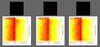
An Agent-based model developed to investigate human dependencies on orally transmitted knowledge under constantly changing environmental conditions.
Generic Operational Simulation of Civil Unmanned Air Vehicle Operations
Hans Fangohr, James Scanlan (Investigators)
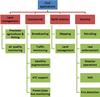
This project creates a generic operational simulation of Unmanned Air Vehicle Operations. UAVs can be valued for their mission-suitability and compared against various configurations.
How far can we stretch the MARTINI?
Syma Khalid (Investigator), Ric Gillams
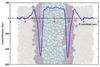
To date, coarse-grained lipid models have generally been parameterised to ensure the correct prediction of structural properties of membranes, such as the area per lipid and the bilayer thickness. The work described here explores the extent to which coarse-grained models are able to predict correctly bulk properties of lipids (phase behaviour) as well as the mechanical properties, such as lateral pressure profiles and stored elastic stress in bilayers. Such an evaluation is crucial for understanding the predictive capabilities of coarse-grained models.

How sensitive is ocean model utility to resolution?
Kevin Oliver (Investigator), Maike Sonnewald
One of the most intriguing problems in recent ocean modeling research is the impact of varying model resolution on model accuracy. Increasing model resolution one includes more of the important processes. However, the increase in accuracy with resolution is unlikely to be linear. Thus, as computational cost increases with resolution, a critical assessment of achieved benefits is prudent. Here we analyse a suite of realistic and compatible global ocean model runs from coarse (1o, ORCA1), eddy-permitting (1/4o, ORCA025) and eddy resolving (1/12o, ORCA12) resolutions. Comparisons of steric height variability (varSH) highlight changes in ocean density structure, revealing impacts on mechanisms such as downwelling and eddy energy dissipation. We assess vertical variability using the covariace of the deep and shallow varSH. Together with assessing isopycnal movements, we demonstrate the influence of deep baroclinic modes and regions where the barotropic flow sheds eddies. Significant changes in the deepwater formation and dispersion both in the Arctic and Antarctic are found between resolutions. The varSH increased from ORCA1 to ORCA025 and ORCA12, particularily in the Southern Ocean and Western Boundary Currents. However, there is no significant covariance between the surface and deep in ORCA1, while ORCA025 and ORCA12 show significant covariance, implying an important missing energy pathway in ORCA1. Comparing ORCA025 and ORCA12 we see significant differences in eddy energy dissipation. We assess the impact of varying model resolution on the mean flow, discussing implications to dissipation pathways on model accuracy, with reference to stochastic parameterisation schemes.
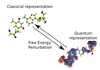
Hybrid quantum and classical free energy methods in computational drug optimisation
Jonathan Essex, Chris-Kriton Skylaris (Investigators), Christopher Cave-Ayland
This work is based around the application of thermodynamics and quantum mechanics to the field of computational drug design and optimisation. Through the application of these theories the calculation of the physical properties of drug-like molecules is possible and hence some predictive power for their pharmaceutical activity in vivo can be obtained.
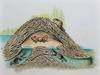
Impact of reciprocal feedbacks between evolution and ecology
Richard Watson, Patrick Doncaster, James Dyke (Investigators), Daniel Power
How do organism's activities affect their evolutionary trajectories? This project uses simulation techniques to evaluate the effects of this feedback.

Integrated in silico prediction of protein-protein interaction motifs
Richard Edwards (Investigator), Nicolas Palopoli, Kieren Lythgow
Many vital protein-protein interactions are mediated by Short Linear Motifs (SLiMs) which are short proteins typically 5-15 amino acids long containing only a few positions crucial to function. This project integrates a number of leading computational techniques to predict novel SLiMs and add crucial detail to protein-protein interaction networks.
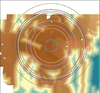
Integrating least-cost models with agent-based simulations: example hedgehog responses to fragmented landscapes
Jason Noble, Patrick Doncaster (Investigators), Angela Watkins
This study presents a novel analysis of an agent-based model of hedgehog movements integrated with a least-cost model of hedgehog dispersal and validated in landscapes with a varying degree of habitat fragmentation. A comparison of the fitness of individual agents reveals that incorporating a simple rule into
individual agents, to better mimic movement choices by real hedgehogs, dramatically affects the relationship between individual fitness and fragmentation.
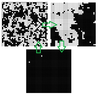
Introducting Defects into the Ising Model
Benjamin Lowe
The well-known Ising model, a model of emergent critical phenomenon and phase transitions, was reimplemented and extended to incorporate the study of defects in the lattice.
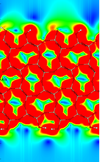
Investigation into the Interfacial Physics of Field Effect Biosensors
Nicolas Green, Chris-Kriton Skylaris (Investigators), Benjamin Lowe
This interdisciplinary research aims to improve understanding of Field Effect Transistor Biosensors (Bio-FETs) and to work towards a multiscale model which can be used to better understand and predict device response.
Is the decline in East African lesser flamingo population a natural concequence of soda ake dynamics?
Seth Bullock
An interdisciplinary approach using palaeoenvironmental data analysis and a modelling is being used investigate the dramatic fluctuations in conditions in the East African Rift Valley soda lakes, and how these changes may be impacting the lesser flamingo population.
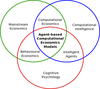
It takes all sorts: the mathematics of people’s behaviour in financial markets
Valerio Restocchi (Investigator), Frank McGroarty, Enrico Gerding
Agent-based models provide a deeper understanding of financial markets than classic models. We model people's behaviour and use agent-based simulations to study financial markets. By analysing the emerging complex dynamics, we achieve a deeper understanding of market participants' behaviours, which are necessary for a deeper comprehension of financial markets themselves.
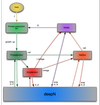
Lagrangian modelling of ecosystem dynamics at the Bermuda Atlantic Time-series Study station
Tom Anderson, Seth Bullock (Investigators), Melissa Saeland
Focus in the marine ecosystem modelling community is starting to shift towards the use of Lagrangian, agent-based models as these are believed to produce more realistic results. The basic assumptions behind these models have not been thoroughly tested, and this project aims to undertake a detailed study of Lagrangian marine ecosystem models, before creating one to investigate the dynamics at the Bermuda Atlantic Time-series Study station (BATS).
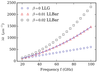
Magnetic dynamics under the Landau-Lifshitz-Baryakhtar equation
Hans Fangohr (Investigator), Weiwei Wang
Magnetic dynamics using the Landau-Lifshitz-Baryakhtar (LLBar) equation that the nonlocal damping is included as well as the scalar Gilbert damping.

Magnon-Driven Domain-Wall Dynamics in the presence of Dzyaloshinskii-Moriya Interaction
Hans Fangohr (Investigator), Weiwei Wang
The domain wall motion induced by spin waves (magnons) in the presence of Dzyaloshinskii-Moriya Interaction is studied in this project.
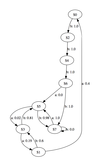
Measuring organisation with statistical complexity
Seth Bullock (Investigator), David Arden
What is a organisation and how can we measure it? In particular, can we automate the process of picking out the emergence of pattern and structure in a noisy system over time?
Micromagnetic simulation of Magnetoelectric Multiferroics
Hans Fangohr (Investigator), Rebecca Carey
The focus of this project is towards the understanding of the magnetic and electric couplings in multiferroic materials, in order to create a magnetoelectric micromagnetic model.
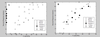
Modelling mechanoreceptor reaction to tissue deformation
Mark Taylor (Investigator), Gwen Palmer
This project involved the modelling of a piece of knee joint capsule, which will produce an electrical output when mechanically stimulated. The model is based on expermental work carried out by P. Grigg and A.H. Hoffman (1982).
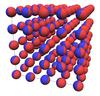
Modelling micromagnetism at elevated temperature
Hans Fangohr, Kees de Groot, Peter de_Groot (Investigators), Dmitri Chernyshenko
We aim to develop a multiscale multiphysics model of
micromagnetism at elevated temperatures with atomistic simulations for
material parameter. The tool will be used to guide the development of the next generation magnetic data storage technology: heat assisted magnetic recording.
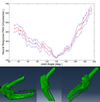
Modelling neuronal activity at the knee joint
Mark Taylor, Tiina Roose (Investigators), Gwen Palmer
The function of the knee joint is reliant on proprioception, which involves the response of nerve endings in the tissues at the joint. This project will be concentrating on the neuronal activity, caused by mechanical stimuli, of the more common receptors found at the knee (Ruffini, Paciniform, Golgi and Nociceptor).
There are three stages to this project:
1. Modelling the behaviour of each individual receptor, with the use of the Hodgkin-Huxley model [1].
2. These models will then be applied to the soft tissues around a knee, where a global deformation of the tissue will result in local stimulation of receptors.
3. The soft tissue models will then be applied to structures in the knee.
[1] - Hodgkin, A.L. and A.F. Huxley, A quantitative description of membrane current and its application to conduction and excitation in nerve. Journal of Physiology, 1952. 117: p. 500-544.
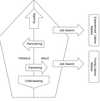
Modelling the Easterlin Effect
Jason Hilton
This project is an attempt to formalise the Easterlin hypothesis in a simulation model and test its plausibility.
The Easterlin Hypothesis, developed by economist Richard Easterlin, purports to describe a mechanism whereby the fertility decisions of a particular cohort of individuals are linked to population level conditions that held sway when they were born The empirical support for the theory is quite strong for the certain periods in the history of the United States, but elsewhere it is circumstantial and patchy. A simulation model may allows us to test under what conditions it may hold and not hold, and also might help inform more general theory building.
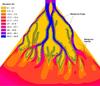
Modelling the morphodynamic evolution of the Ganges-Brahmaputra-Meghna (GBM) Delta over centennial time scales
Stephen Darby (Investigator), Balaji Angamuthu
Around 0.5 Billion people live in deltaic environments where they are threatened by flooding and land loss frequently. Yet, our understanding of the threats posed by land dynamic process remains limited. In this work, we try to address this issue through a land dynamic simulation of the largest and most populated of all the deltas, the GBM Delta, using the CFD software Delft3D for a range of climate change and management scenarios. The results provide new insight into the factors controlling past morphodynamics that, in turn, are helpful when assessing the possible trajectories of future evolution.

Models of Avian Flocking
Edward Butler (Investigator)
This research review project explores current state of avian flock modelling research, exploring how ideas have developed since the earliest theories dating back to the 1930s.
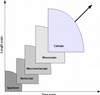
Multiscale Modelling of Cellular Calcium Signalling
Hans Fangohr, Jonathan Essex (Investigators), Dan Mason
Calcium ions play a vitally important role in signal transduction and are key to many cellular processes including muscle contraction and cell apoptosis (cell death). This importance has made calcium an active area in biomedical science and mathematical modelling.
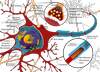
Multiscale Modelling of Electrochemical Processes in Neurons
John Chad (Investigator), Stuart George
Using asymptotic expansions to determine how the signalling behaviour of neurons is related to their microstructure.
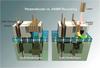
Multiscale models of magnetic materials at elevated temperatures
Denis Kramer (Investigator), Jonathon Waters
This project will develop and apply multi-scale modelling approaches to investigate thermal fluctuation effects in magnetic materials.

MXL Project
Mark Taylor, Junfen Shi (Investigators)
‘MXL’ is short for “Enhanced patient safety by computational Modelling from clinically available X-rays to minimise the risk of overload and instability for optimised function and Longevity”. This is an international EU-funded project which the Bioengineering Sciences Research Group at Southampton is involved in. For more information, visit http://www.m-x-l.eu
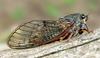
New Forest Cicada Project
Alexander Rogers, Geoff Merrett (Investigators), Davide Zilli, Oliver Parson
Rediscover the critically endangered New Forest cicada with crowdsourced smartphone biodiversity monitoring techniques.
Nonequilibrium Dynamics of Atomic Gases in Optical Lattices
Sophie Marika Reed
Many-body, quantum systems exhibit emergent properties which allows for quantum events to influence properties on macroscopic scales. Such emergent properties are studied using stochastic phase-space techniques.
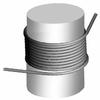
Nonlinear Optics in Structured Material
Peter Horak, Neil Broderick (Investigators)
Structured materials such as photonic crystals, optical fibres, Bragg gratings etc. are the ideal material for nonlinear optics. Properly engineered materials allows one to control which nonlinear interactions are observed and enhanced whilst other nonlinear interactions can be neglected. This work looks both at fundamental ideas as well as the fabrication of devices for advanced telecommunications.
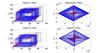
On the applicability of nonlinear timeseries methods for partial discharge analysis
Paul Lewin (Investigator), Lyuboslav Petrov
The governing processes of Partial Discharge (PD)
phenomena trigger aperiodic chains of events resulting in ’ap-
parently’ stochastic data, for which the widely adopted analysis
methodology is of statistical nature. However, it can be shown,
that nonlinear analysis methods can prove more adequate in
detecting certain trends and patterns in complex PD timeseries.
In this work, the application of nonlinear invariants and phase
space methods for PD analysis are discussed and potential pitfalls
are identified. Unsupervised statistical inference techniques based
on the use of surrogate data sets are proposed and employed for
the purpose of testing the applicability of nonlinear algorithms
and methods. The Generalized Hurst Exponent and Lempel Ziv
Complexity are used for finding the location of the system under
test on the spectrum between determinism and stochasticity. The
algorithms are found to have strong classification abilities at
discerning between surrogates and original point series, giving
motivation for further investigations.
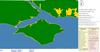
Operational Simulation of the Solent Search-and-Rescue environment
James Scanlan, Kenji Takeda, Hans Fangohr (Investigators), Ben Schumann
This project aims to identify useful metrics for a proposed Search-and-Rescue UAV and test it virtually in a realistic environment.
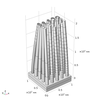
Optical Characterisation of Black Silicon for Photovoltaics Using the Finite Element Method
Jack Tyson (Investigator)
Here we present a novel method of simulating the reflectance spectra of black silicon solar cells using the finite element method. Designed in COMSOL Multiphysics is a new set of algorithm-controlled-geometries rendering a vast array of different structural permutations of silicon nanowires. Our model focused on the variation of this geometry within customisable predefined conditions in large output quantities, collated and averaged to reliably determine the reflectance of an entire black silicon solar cell.
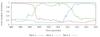
Origins of Evolvability
Richard Watson, Markus Brede (Investigators), William Hurndall
This project examined the putative evolvability of a Lipid World model of fissioning micelles. It was demonstrated that the model lacked evlovability due to poor heritability. Explicit structure for micelles was introduced along with a spatially localised form of catalysis which increased the strength of selection as coupling between potential chemical units of heredity were reduced.
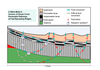
Porous Media and Hydrothermal Circulation in Weakened Ocean Crust
Formation of oceanic crust is an interplay between magma and the cooling hydrothermal system above that its own heat drives. To understand this system we must understand where and how water circulates through the crust.
Ocean crust is riddled with faults and other permeable pathways along which water preferentially flows. We seek to use basic numerical models of circulation in porous media to understand how much of an influence on crust formation these anomalous features have, compared to the bulk, unfractured crust.
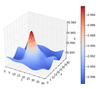
Precision study of critical slowing down in lattice simulations of the CP^{N-1} model
Jonathan Flynn, Andreas Juttner (Investigators), Andrew Lawson
This project involves the study of critical slowing down (CSD): a property that may arise when taking measurements in Monte Carlo simulations. In order to study and quantify this phenomenon we have performed extensive simulations of the CP^{N-1} model. By studying the properties of the Monte Carlo algorithms in this model, we hope to make algorithmic improvements that can then be employed in simulations of physical quantum field theories, such as in lattice quantum chromodynamics (lattice QCD).

Predicting Available Energy in Energy Harvesting Wireless Sensor Networks
Geoff Merrett (Investigator), Davide Zilli
Is it possible to predict how much energy a sun-light or wind powered wireless sensor node can harvest and tune its sensing pattern accordingly?
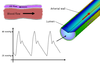
Preventing Alzheimer's Disease: A Multiphysics Simulation Approach
Neil Bressloff, Giles Richardson, Roxana-Octavia Carare (Investigators), Alexandra Diem
Experimental research has identified the causes of many diseases, such as Alzheimer's Disease. However, finding an effective treatment is very cost- and time-intensive and sacrifices many animals and does not guarantee success. In this PhD project, we investigate the driving force of solute drainage in the brain using multiphysics simulations in order to identify possible ways of preventing dementia.
pyQCD
Matthew Spraggs
A basic Python package to perform coarse lattice QCD simulations on desktop and workstation computers.
Quantifying Collective Construction
Seth Bullock (Investigator), Nicholas Hill
This was an initial investigation into how best to develop quantifying and discriminating measures of both the processes and results of collective construction.
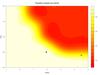
Reforging the Wedding Ring: Exploring a Semi-Artificial Model of Population for the United Kingdom with Gaussian process emulators
Jason Hilton
Note: Jakub Bijak from Social Science is the lead author on this project, which is forthcoming in Demographic Research (http://www.demographic-research.org/)
Co-Authors: Eric Silverman, Viet Dung Cao
We extend the „Wedding Ring? agent-based model of marriage formation to include some empirical information on the natural population change for the United Kingdom together with behavioural explanations that drive the observed nuptiality trends.
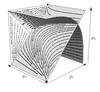
Renormalisation group approach to 1D cellular automata with large updating neighbourhoods
Iain Weaver, Adam Prugel-Bennett (Investigators)
We study self-similarity in one-dimensional probabilistic cellular automata (PCA) by applying a real-space renormalisation technique to PCA with increasingly large updating neighbourhoods. By studying the flow about the critical point of the renormalisation, we may produce estimates of the spatial scaling properties of critical PCA.
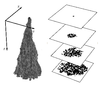
Renormalisation of 2D cellular automata with an absorbing state
Adam Prugel-Bennett, Iain Weaver (Investigators)
We describe a real-space renormalisation scheme for non-equilibrium probablistic cellular automata (PCA) models, and apply it to a two-dimensional binary PCA. An exact renormalisation scheme is rare, and therefore we provide a method for computing the stationary probability distribution of states for such models with which to weight the renormalisation, effectively minimising the error in the scale transformation.
Replication of Sayama Group Decision Model
Jason Noble (Investigator), Jonathan Gray
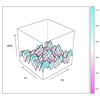
Replication of a model of group decision making from Sayama et al. (2011), with a revised methodology that alters a conclusion from the original paper.
Scalability of Energy Efficient Routing Algorithms in Wireless Sensor Networks
Geoff Merrett (Investigator), Davide Zilli
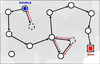
This project compares two broad classes of routing algorithms for Wireless Sensor Networks, message flooding and single path, by means of a simulation model. In particular, we want to understand how the two scale in terms of energy efficiency on large networks of sensors.
Self Interest & the Evolutionary Optimisation of Adaptive Trading Agents for Continuous Double Auctions
Frank McGroarty, Enrico Gerding (Investigators), Ash Booth
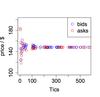
One cannot escape the recent crises in economics and the lack of understanding of financial markets that has been highlighted by them. Improvements to current market models are already being made and a realisation of the power of agent based modelling in such models is evident. In this project we seek to explore an existing model by Cliff of trader behaviour in continuous double auctions. We investigate the strategies that arise in such auctions when trader parameters are evolved with intent to maximise personal profit. Results show different trading strategies to those evolved by Cliff and explanations are given with regards to the self-interest.
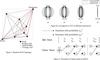
Self Organized Network Routing using Quantum Evolutionary Methods
Lajos Hanzo (Investigator), Dimitrios Alanis
Self Organized Networks (SON) may consist of a large number of nodes, which could be fully interconnected. Optimizing its performance satisfying various Quality of Service (QoS) requirements is a quite complex procedure and the optimization problem belongs to the family of the Travelling Salesman Problems (TSP) which has been proven to be NP-hard as the number of nodes increases. In this project, various suboptimal methods are used in order to tackle this multi-objective optimization problem; in particular, the Ant Colony Optimization (ACO) and its quantum inspired counterpart (QACO) are being employed in order to reduce complexity.
Sensitivity of the critical depth to the choice of particle movement rules in Lagrangian models and the consequences for the predicted timing of the spring bloom
Tom Anderson (Investigator), Melissa Saeland
Individual-based (Lagrangian) models lend themselves to the study of the controls of the spring bloom in the ocean, due to their ability to represent both the turbulence and the phytoplankton motion. Here, we use a Lagrangian phytoplankton model to test some of the most prevalent hypotheses (e.g. critical depth and critical turbulence).
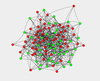
Separation of timescales in models of complex networks
Seth Bullock (Investigator), Elisabeth zu-Erbach-Schoenberg, Connor McCabe
In many real-world systems several processes act on the system state. The way these processes interact can have implications for the resulting system state. We investigate how separation of the timescales of two processes influences the system's equilibrium state.
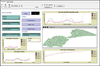
Simulating Household Decision Making in Rural Malawi
James Dyke, Kate Schreckenberg (Investigators), Samantha Dobbie
A scoping exercise to determine whether data collection tools of the social sciences can be used effectively in the construction of empirical ABM. Focus fell upon simulating drought coping strategies of Malawian smallholders. Model implementation enabled inferences to be made concerning the impact of drought and input subsidies upon smallholder food security.
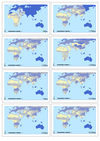
Simulating Human Expansion in the Early Pleistocene
Seth Bullock, Fraser Sturt (Investigators), Iza Romanowska
Using Agent-based modelling to investigate the first human dispersal almost 2 million years ago.

Simulating Multi-Agent Negotiation with Agents that use Incomplete Information
Enrico Gerding (Investigator), Darius Pepe Falahat
An investigation into multi-agent negotiation where the participants have incomplete information about each other. This project consisted of a literature review and creating a simulation model based on the research being reviewed.

Simulating Sleeping Sickness: a two-host agent-based model
Jason Noble, Peter Atkinson (Investigators), Simon Alderton
Sleeping sickness is a vector-borne, parastic disease which affects millions of people across 36 sub-Saharan African countries. Using agent-based models, we aim to gain a greater understanding of the interactions between the tsetse fly vector and both animal and human hosts.
Building an accurate representation will allow the testing of local interventation scenarios including the closing of watering holes, and the selective spraying of cattle with insecticides.
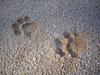
Simulation modelling of habitat permeability for mammalian wildlife
Patrick Doncaster, Jason Noble (Investigators), Angela Watkins
Using and integrating least-cost models and agent-based simulations to explore the way in which mammals interact with, and hence move, through fragmented landscapes.

Simulation of Parking Choice Behaviour
Ben Waterson, Hans Fangohr (Investigators), James Snowdon
Exploring how psychological models of individual parking search behaviours can be combined into an accurate simulation of vehicle flows, allowing for assessment of the impact on searching traffic of different demand/ supply ratios, different driver population characteristics and different charging regimes.
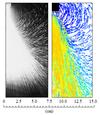
Simulations investigating droplet diameter-charge models, for predicting electrostatically atomized dielectric liquid spray chracteristics
Gabriel Amine-Eddine (Investigator)
Liquid sprays are atomized using electrostatic methods in many scienti fic, industrial and engineering applications. Due to jet and droplet breakup mechanisms, these spray plumes contain a range of drop diameters with differing droplet charge levels. Using an transient charged spray CFD code, simulations have been performed to investigate charge-diameter relationship models for predicting dynamics of poly-disperse and electrostatically atomized hydrocarbon sprays.
The methodology developed can be readily extended towards high-pressure spray applications, where secondary atomization plays a dominant role within the spray dynamics and subsequent performance of the spray itself.
Amine-Eddine, G. H. and Shrimpton, J. S. (2013), On simulations investigating droplet diameter–charge distributions in electrostatically atomized dielectric liquid sprays. Int. J. Numer. Meth. Fluids, 72: 1051–1075. doi:10.1002/fld.3776

Skyrmionic states in confined nanostructures
Hans Fangohr (Investigator), Marijan Beg
An ever increasing need for data storage creates great challenges for the development of high-capacity storage devices that are cheap, fast, reliable, and robust. Because of the fundamental constraints of today's technologies, further progress requires radically different approaches. Magnetic skyrmions are very promising candidates for the development of future low-power, high-capacity, non-volatile data storage devices.

Spatial Mobility in the Formation of Agent-Based Economic Networks
Antonella Ianni, Seth Bullock (Investigators), Camillia Zedan
An investigation into the effect of spatial mobility on endogenous economic network formation.
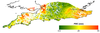
Spatial variability of the atmosphere in southern England
Joanna Nield, Jason Noble, Edward Milton (Investigators), Robin Wilson
No-one really knows how variable key atmospheric parameters such as Aerosol Optical Thickness and Water Vapour content are over relatively small areas. This study aims to find out!

Stability of chiral structures in magnetic nanodisks
Hans Fangohr, Weiwei Wang (Investigators), David Cortes
This project is aimed to study the stability of skyrmionic and helical equilibrium states in magnetic nanodisks, using computational simulations.
Sustainable domain-specific software generation tools for extremely parallel particle-based simulations
Chris-Kriton Skylaris (Investigator)
A range of particle based methods (PBM) are currently used to simulate materials in chemistry, engineering, physics and biophysics. The 4 types of PBM considered directly in the proposed are molecular dynamics (MD), the ONETEP quantum mechanics-based program, discrete element modelling (DEM), and smoothed particle hydrodynamics (SPH).
The overall research objective is to develop a sustainable tool that will deliver, in the future, cutting edge research applicable to applications ranging from dam engineering to atomistic drug design.
TEDx: Closing the Loop: Entropy Accounting for a Sustainable World
Stuart Bartlett (Investigator)
This is a TEDx talk that I gave on some ideas I've had about the large-scale thermodynamic organisation of life on Earth. While these ideas probably aren't new, I believe they can teach us something about the way in which we think about energy and the 'consumption' of goods and energy.

Test and Rest
Hans Fangohr (Investigator), Evander DaCosta, James Graham, Oliver Laslett
Regression and system testing, automatic execution of testing - establishing best practice.

Testing an interaction game on relationships.
Seth Bullock (Investigator), Anastasia Eleftheriou
The aim of this project is to examine how attractiveness is related to hypothetical risky sexual behaviour. The term `risky sexual behaviour' refers to having multiple sexual partners without the use of a condom. Data will be collected using questionnaires in order to investigate the influence of attractiveness on intentions towards engaging in unprotected sexual intercourse. A primary research question is whether perceived attractiveness of a potential partner affects the reported likelihood of having sex and/or using a condom.
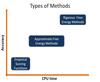
The application and critical assessment of protein-ligand binding affinities
Jonathan Essex (Investigator), Ioannis Haldoupis
A method that can accurately predict the binding affinity of small molecules to a protein target would be imperative to pharmaceutical development due to the time and resources that could be saved. A head-to-head comparison of such methodology, ranging from approximate methods to more rigorous methods, is performed in order to assess their accuracy and utility across a range of targets.
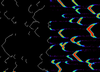
The application of automated pattern metrics to surface moisture influences on modelled dune field development
Robin Wilson, Joanna Nield (Investigators)
Areas of sand dunes (known as dunefields) develop complex patterns over time. These are influenced by both the past and present environmental conditions, including surface moisture, vegetation distribution and human impact. This project develops a method of automated pattern analysis which allow the patterns produced by a large number of sand dune evolution simulations (performed using the DECAL model) to be quantified over time.
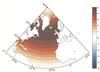
The Atlantic Meridional Overturning Circulation’s Response to Variable Buoyancy Forcing
Kevin Oliver (Investigator), Edward Butler
An investigation into the impact of periodic variations in surface buoyancy forcing on the mean strength of ocean circulation; in particular, the Atlantic Meridional Overturning Circulation.
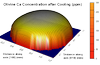
The Ca-geospeedometer - A tool for investigating the processes that generate oceanic crust
We quantify the errors inherent in the current methods of geospeedometry, which lets one obtain the cooling rate of a rock, using mineral trace element chemistry. Calcium-in-Olivine geospeedometry is useful for deep ocean crust.
We want to use this proxy to figure out how ocean crust actually accretes, it provides key evidence as to how magma chambers and hydrothermal systems interact to produce new lithosphere. But to do so we first have to determine how reliable the method is and therefore how much can be inferred from results.
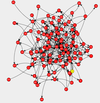
The Endogenous Formation of Economic Networks
Antonella Ianni, Seth Bullock (Investigators), Camillia Zedan
An investigation into endogenous network formation using a simple agent-based approach.
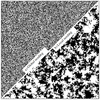
The importance of timescales for the emergence of environmental self-regulation
Iain Weaver, James Dyke (Investigators)
Models which explore the possibilities of emergent self-regulation in the Earth system often assume the timescales associated with changes in various sub-systems to be predetermined. We analyse a classic model of environmental self-regulation, Daisyworld, and interpret the original equations for model temperature, changes in insolation, and self-organisation of the biota as an important separation of timescales.
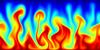
The Maximum Entropy Production Principle and Natural Convection
Seth Bullock, James Dyke (Investigators), Stuart Bartlett
In this project I wanted to perform some tests of the so-called Maximum Entropy Production Principle (MEPP) in the context of buoyancy-driven convection in a system with negative feedback boundary conditions.

The Ocean's Gravitational Potential Energy Budget in a Coupled Climate Model
Kevin Oliver (Investigator), Edward Butler
This study examines, in a unified fashion, the budgets of ocean gravitational potential energy (GPE) and available gravitational potential energy (AGPE) in the control simulation of the coupled atmosphere–ocean general circulation model HadCM3.
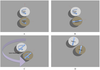
The Origins of Communication Revisited
Jason Noble (Investigator), Jordi Arranz
Quinn (2001) sought to demonstrate that communication be- tween simulated agents could be evolved without pre-defined communication channels. Quinn’s work was exciting because it showed the potential for ALife models to look at the real origin of communication; however, the work has never been replicated. In order to test the generality of Quinn’s result we use a similar task but a completely different agent architecture. We find that qualitatively similar behaviours emerge, but it is not clear whether they are genuinely communicative. We extend Quinn’s work by adding perceptual noise and internal state to the agents in order to promote ritualization of the nascent signal. Results were inconclusive; philosophical implications are discussed.

The Philosophy of Complexity
Greg Fisher
How we think is in large part socially constructed, which means we inheret cognitive ways of framing and making sense of the world around us.
The Enlightenment saw an important shift towards reductionism and atomistic thinking, which on the one hand helped facilitate many stunning successes in science but on the other, we have applied these principles in domains when we perhaps should not e.g. in economics.
In this project I would like to explore how philosophy can benefit the complexity revolution, and how complexity theory can support philosophy.
The response of the Bergmann glial cell to synaptic activity
Giles Richardson (Investigator), Stuart George
We model the potential changes induced in the Bergmann glial cell by synaptic activity in neighbouring neurons.
The Role of Information in Price Discovery
Antonella Ianni, Seth Bullock (Investigators), Camillia Zedan
The recent economic crisis has highlighted a continued vulnerability and lack of understanding in the financial markets. In order to overcome this, many believe that current market models must be improved. Recently, a trend towards agent-based modelling has emerged. Viewing the economy as a complex system is beginning to be seen as key to explaining certain market characteristics that were originally considered anomalies.
One of the fundamental assumptions in economics is that of information efficiency: that the price of a stock reflects its worth, that all possible information about a security is publicly known, and that any changes to price take place instantaneously. In reality, however, this is not the case.
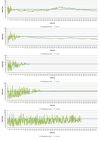
This project considers the use of agents in modelling economic systems and demonstrates the effect of information levels on price discovery using a simple market simulation.
The Role of the Biota in the Carpenter Model on Lake Eutrophication
James Dyke (Investigator), Alexandra Diem
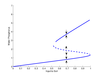
The Carpenter model is a useful and simple model to predict the eutrophication of shallow lakes via phosphorus input. This project aimed at resolving the function of the biota, which play a major role in the phosphorus dynamics, but are so far only implicitly modelled, and extending the model to explicitly represent them.
The Social-cognitive Niche: An Exploration of the Co-evolutionary Relationship between Human Mind and language, with a Particular Focus of the Self-organisational properties of the Emergence of Symbolic Representation.
Jason Noble, Glyn Hicks (Investigators), Lewys Brace
This work explored the relationship between the origin and subsequent evolution of the human mind and language; a relationship that is believed to be symbiotic in nature. This piece aimed to achieve two objectives. Firstly, it set out a theoretical framework, using the principles of complexity theory and self-organisation, which attempts to explain this relationship from a holistic perspective.
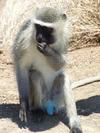
Secondly, it presented an agent-based model of a vervet monkey social group, which sought to investigate the variables that were perceived to underpin the emergence of symbolic representation within a population of language users.
The belief here was that, by understanding the influence of these variables, one would be able to better understand the genesis of the aforementioned relationship.
The tarsal intersegmental reflex control system in the locust hind leg
David Simpson, Philip Newland (Investigators), Alicia Costalago Meruelo
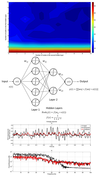
Locomotion is vital for vertebrates and invertebrates to survive. Despite that feet are responsible for stability and agility in most animals, research on feet movements and their reflexes is scarce.
In this thesis, the tarsal reflex responses of locust will be studied and modelled with ANNs to achieve a deeper comprehension of how stability and agility is accomplished.
The choice of ANNs is linked to the applicability of the method into other fields, such as technological designs or medical treatment.
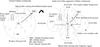
Today's Computation Enabling Tomorrow's Seamless Communication
Lajos Hanzo (Investigator), Varghese Thomas
Radio Over Fibre (ROF) is a communication technique that aims to gainfully amalgamate the benefits of optical and wireless communication, while keeping the system cost low. This technique would support the next generation of wireless services.
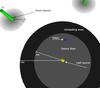
Towards design patterns for robot swarms
Richard Crowder, Seth Bullock (Investigators), Lenka Pitonakova
Swarm robotics is an inter-disciplinary field that seeks to design the behaviour of robots that can cooperate effectively on tasks like search and retrieval, reconnaissance, construction, etc. In this project, we are aiming towards a theoretical understanding of swarm intelligence and the development of design patterns for effective robot swarms.
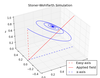
Understanding Stochastic Processes in Interacting Spin Models
Oliver Laslett
Applying efficient computational models to compute Langevin dynamics and master equation equilibrium solutions for interacting magnetic spin systems.

Understanding the Role of Recruitment in Robot Foraging
Seth Bullock, Richard Crowder (Investigators), Lenka Pitonakova
It is shown that recruitment among foraging robots is useful when resources are hard to find, but that the extra cost associated with such robots is not returned when there are many locations to gather from or simply when the relative gain from using communication is low.
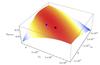
Using MEP to determine parameter values of ocean and atmosphere diffusivity
Kevin Oliver, James Dyke (Investigators), Maike Sonnewald
Entropy budgets can potentially offer new and valuable insights into the dissipation of energy in the ocean system. Specifically, if one assumes the Earth system maximises the dissipation of energy, one can use this as a guiding principle maximising the internal entropy production. In this study, resultant temperature distributions from a four box ocean-atmosphere-ice model are used to assess to what extent such considerations could ameliorate the need for tuning parameter values associated with oceanic and atmospheric diffusivity. Results from a standard implementation with fixed, empirically determined, parameters were compared to one where the maximum entropy production principle is applied to determine the value of oceanic and atmospheric diffusivity parameters. These methods have been successfully applied to cloud fraction and convection in the atmosphere.
The MEP principle suggested using diffusivity values of 3.3×10¹⁴ W K ?1 and 3.2×10¹⁴ W K ?1
for the ocean and atmosphere respectively, where the empirical values were 2.0 × 10¹⁴ W K ?1
and 1.0 × 10¹⁴ W K ?1 . The oceanic temperatures of the MEP implementation were 3 and -1oC
away the high and low latitude observed ocean temperatures respectively, while the empirical
implementation was -5 and 3oC away, largely within the observational standard deviation of
8 and 2? C respectively. For the atmospheric values, MEP implementation was 3W m?2 away
from the high latitude observed value, while the empirical implementation was 6W m?2 away,
both within the standard deviation of 13.2W m?2 . However, in the low latitudes this reverses,
with the empirical implementation being only -16W m?2 off while the MEP implementation
is -21W m?2 off. However, both figures are outside the range of the standard deviation of
4.2W m?2 . Overall, both methods were found to be very close to oceanic observations. This
confirms that in the model used, the assumption of maximal dissipation of energy is reasonable.
Furthermore, the nature of the landscape of internal entropy production created by the
oceanic and atmospheric diffusivity was found to be fairly smooth, with non-linearities mainly
coming from ice albedo. Assuming the Earth system is in a state of maximal energy dissipa-
tion, applying the MEP principle successfully may depend on such a smooth, easily optimisable
landscape. Thus, the successful application of the MEP principle could be much more difficult
if attempting to aid parametrisation in more detailed ocean models, as these are likely to have
internal entropy production landscapes with local maxima. Nevertheless, results presented
are very promising, and encourage further exploration of to what extent this principle could
be applied to ameliorate the need for tuning parameters in light of lacking information.
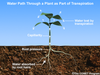
Validation of a spatial-temporal soil water movement and plant water uptake model
Tiina Roose, Sevil Payvandi (Investigators), James Heppell
We develop a model that estimates the water saturation level within the soil at different depths, and the uptake of water by the root system. Data from Smethurst et al (2012) is used to validate our model and obtain a fully calibrated system for plant water uptake. When compared quantitatively to other models such as CROPWAT, our model achieves a better fit to the experimental data because of the simpler, first, second and third order terms present in the boundary condition, as opposed to complicated non-linear functions.

Validation of GPS-derived water vapour estimates
Joanna Nield, Jason Noble, Edward Milton (Investigators), Robin Wilson
Measurements from GPS base stations can be processed to provide estimates of the water vapour content in the atmosphere. These are lots of these base stations across the world and they take measurements very frequently, making them perfect data sources for scientific use. However, we need to understand their accuracy - and this project aims to do this.
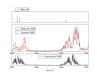
Vibrational spectroscopy from ab initio molecular dynamics
Hans Fangohr, Chris-Kriton Skylaris (Investigators), Valerio Vitale
In this project I used the Fourier transform of the time correlation function (FTTCF) formalism, that allows to compute the vibrational spectra of molecules both in gas and condensed phase, at finite temperature, in a single ab initio molecular dynamics simulation.
People
 Peter Atkinson
Professor, Geography (FSHS)
 Jakub Bijak
Professor, Social Sciences (FSHS)
 Sally Brailsford
Professor, Management (FBL)
 Neil Bressloff
Professor, Engineering Sciences (FEE)
 Seth Bullock
Professor, Electronics and Computer Science (FPAS)
 Stephen Darby
Professor, Geography (FSHS)
 Kees de Groot
Professor, Electronics and Computer Science (FPAS)
 Jonathan Essex
Professor, Chemistry (FNES)
 Hans Fangohr
Professor, Engineering Sciences (FEE)
 Jonathan Flynn
Professor, Physics & Astronomy (FPAS)
 Lajos Hanzo
Professor, Electronics and Computer Science (FPAS)
 Paul Lewin
Professor, Electronics and Computer Science (FPAS)
 Frank McGroarty
Professor, Management (FBL)
Edward MiltonProfessor, Geography (FSHS)
 Philip Newland
Professor, Biological Sciences (FNES)
 James Scanlan
Professor, Engineering Sciences (FEE)
 Suleiman Sharkh
Professor, Engineering Sciences (FEE)
John ShrimptonProfessor, Engineering Sciences (FEE)
 Mark Taylor
Professor, Engineering Sciences (FEE)
 Stephen Turnock
Professor, Engineering Sciences (FEE)
Hendrik UlbrichtProfessor, Physics & Astronomy (FPAS)
 Giampaolo D'Alessandro
Reader, Mathematics (FSHS)
 Patrick Doncaster
Reader, Biological Sciences (FNES)
Nicolas GreenReader, Electronics and Computer Science (FPAS)
 Peter Horak
Reader, Optoelectronics Research Centre
Andreas JuttnerReader, Physics & Astronomy (FPAS)
Rohan LewisReader, Medicine (FM)
 Robert Marsh
Reader, National Oceanography Centre (FNES)
 Adam Prugel-Bennett
Reader, Electronics and Computer Science (FPAS)
 Giles Richardson
Reader, Mathematics (FSHS)
 Tiina Roose
Reader, Engineering Sciences (FEE)
 Paul Skipp
Reader, Biological Sciences (FNES)
 Thomas Blumensath
Senior Lecturer, Institute of Sound & Vibration Research (FEE)
Markus BredeSenior Lecturer, Electronics and Computer Science (FPAS)
 Roxana-Octavia Carare
Senior Lecturer, Medicine (FM)
 John Chad
Senior Lecturer, Biological Sciences (FNES)
 Richard Crowder
Senior Lecturer, Electronics and Computer Science (FPAS)
 Antonella Ianni
Senior Lecturer, Social Sciences (FSHS)
 Joanna Nield
Senior Lecturer, Geography (FSHS)
 David Simpson
Senior Lecturer, Institute of Sound & Vibration Research (FEE)
 Fraser Sturt
Senior Lecturer, Humanities (FH)
 Richard Watson
Senior Lecturer, Electronics and Computer Science (FPAS)
Mohamed BakoushLecturer, Management (FBL)
 Neil Broderick
Lecturer, Optoelectronics Research Centre
 James Dyke
Lecturer, Electronics and Computer Science (FPAS)
 Jane Gibson
Lecturer, Biological Sciences (FNES)
 Ian Hawke
Lecturer, Mathematics (FSHS)
 Glyn Hicks
Lecturer, Humanities (FH)
 Denis Kramer
Lecturer, Engineering Sciences (FEE)
 Dina Shona Laila
Lecturer, Engineering Sciences (FEE)
 Geoff Merrett
Lecturer, Electronics and Computer Science (FPAS)
 Kevin Oliver
Lecturer, National Oceanography Centre (FNES)
 Alexander Rogers
Lecturer, Electronics and Computer Science (FPAS)
Kate SchreckenbergLecturer, Civil Engineering & the Environment (FEE)
 Chris-Kriton Skylaris
Lecturer, Chemistry (FNES)
 Anatoliy Vorobev
Lecturer, Engineering Sciences (FEE)
 Ben Waterson
Lecturer, Civil Engineering & the Environment (FEE)
 Tom Anderson
Principal Research Fellow, National Oceanography Centre (FNES)
 Syma Khalid
Principal Research Fellow, Chemistry (FNES)
 Richard Boardman
Senior Research Fellow, Engineering Sciences (FEE)
 Reno Choi
Senior Research Fellow, Geography (FSHS)
Felipe Alves PortelaResearch Fellow, Engineering Sciences (FEE)
 Aleksander Dubas
Research Fellow, Engineering Sciences (FEE)
 Jacek Dziedzic
Research Fellow, Chemistry (FNES)
Btissam Er-RahmadiResearch Fellow, Management (FBL)
 Jason Hilton
Research Fellow, Social Sciences (FSHS)
 Rob Mills
Research Fellow, Electronics and Computer Science (FPAS)
 Jason Noble
Research Fellow, Electronics and Computer Science (FPAS)
 Gwen Palmer
Research Fellow, Engineering Sciences (FEE)
 Sevil Payvandi
Research Fellow, Engineering Sciences (FEE)
 Robin Wilson
Research Fellow, Geography (FSHS)
- -Postgraduate Research Student, Electronics and Computer Science (FPAS)
 Nana Okra Abankwa
Postgraduate Research Student, Engineering Sciences (FEE)
 Joseph Abram
Postgraduate Research Student, Electronics and Computer Science (FPAS)
 Maximilian Albert
Postgraduate Research Student, Engineering Sciences (FEE)
 Roxana Aldea
Postgraduate Research Student, Mathematics (FSHS)
 Simon Alderton
Postgraduate Research Student, Geography (FSHS)
 Gabriel Amine-Eddine
Postgraduate Research Student, Engineering Sciences (FEE)
Balaji AngamuthuPostgraduate Research Student, Geography (FSHS)
 David Arden
Postgraduate Research Student, Electronics and Computer Science (FPAS)
 Jordi Arranz
Postgraduate Research Student, Electronics and Computer Science (FPAS)
 Alice Ball
Postgraduate Research Student, Electronics and Computer Science (FPAS)
 Stuart Bartlett
Postgraduate Research Student, Electronics and Computer Science (FPAS)
 Ioannis Begleris
Postgraduate Research Student, Engineering Sciences (FEE)
 Harry Beviss
Postgraduate Research Student, Electronics and Computer Science (FPAS)
 Ash Booth
Postgraduate Research Student, Electronics and Computer Science (FPAS)
 Lewys Brace
Postgraduate Research Student, Electronics and Computer Science (FPAS)
 Rory Brown
Postgraduate Research Student, Civil Engineering & the Environment (FEE)
 Edward Butler
Postgraduate Research Student, Electronics and Computer Science (FPAS)
 Rebecca Carey
Postgraduate Research Student, Engineering Sciences (FEE)
 Christopher Cave-Ayland
Postgraduate Research Student, Electronics and Computer Science (FPAS)
 Paul Chambers
Postgraduate Research Student, Engineering Sciences (FEE)
 Dmitri Chernyshenko
Postgraduate Research Student, Engineering Sciences (FEE)
 David Cortes
Postgraduate Research Student, Engineering Sciences (FEE)
 Alicia Costalago Meruelo
Postgraduate Research Student, University of Southampton
 Christopher Crispin
Postgraduate Research Student, Engineering Sciences (FEE)
 Evander DaCosta
Postgraduate Research Student, Electronics and Computer Science (FPAS)
 Bob De Caux
Postgraduate Research Student, Electronics and Computer Science (FPAS)
 Alexandra Diem
Postgraduate Research Student, Engineering Sciences (FEE)
 Samuel Diserens
Postgraduate Research Student, Engineering Sciences (FEE)
 Samantha Dobbie
Postgraduate Research Student, Electronics and Computer Science (FPAS)
 Anastasia Eleftheriou
Postgraduate Research Student, Electronics and Computer Science (FPAS)
Graham ElliottPostgraduate Research Student, Electronics and Computer Science (FPAS)
 Robert Entwistle
Postgraduate Research Student, Engineering Sciences (FEE)
 Darius Pepe Falahat
Postgraduate Research Student, Electronics and Computer Science (FPAS)
 Greg Fisher
Postgraduate Research Student, Electronics and Computer Science (FPAS)
 Stuart George
Postgraduate Research Student, Mathematics (FSHS)
 Ric Gillams
Postgraduate Research Student, Chemistry (FNES)
 Stephen Gow
Postgraduate Research Student, Engineering Sciences (FEE)
James GrahamPostgraduate Research Student, Electronics and Computer Science (FPAS)
 Jonathan Gray
Postgraduate Research Student, Social Sciences (FSHS)
 Joshua Greenhalgh
Postgraduate Research Student, Engineering Sciences (FEE)
 Ioannis Haldoupis
Postgraduate Research Student, Chemistry (FNES)
 James Harrison
Postgraduate Research Student, Engineering Sciences (FEE)
 Garvin Haslett
Postgraduate Research Student, Electronics and Computer Science (FPAS)
 James Heppell
Postgraduate Research Student, Electronics and Computer Science (FPAS)
Nicholas HillPostgraduate Research Student, Electronics and Computer Science (FPAS)
 Jason Hilton
Postgraduate Research Student, Social Sciences (FSHS)
 William Hurndall
Postgraduate Research Student, Electronics and Computer Science (FPAS)
 Adam Jackson
Postgraduate Research Student, Electronics and Computer Science (FPAS)
 Guy Jacobs
Postgraduate Research Student, Electronics and Computer Science (FPAS)
 Leo Jofeh
Postgraduate Research Student, Electronics and Computer Science (FPAS)
 Oliver Laslett
Postgraduate Research Student, Civil Engineering & the Environment (FEE)
Andrew LawsonPostgraduate Research Student, Physics & Astronomy (FPAS)
 Edwin Lizarazo
Postgraduate Research Student, Physics & Astronomy (FPAS)
 Benjamin Lowe
Postgraduate Research Student, Electronics and Computer Science (FPAS)
 David Lusher
Postgraduate Research Student, Engineering Sciences (FEE)
 Sam Mangham
Postgraduate Research Student, Electronics and Computer Science (FPAS)
 Vincent Marmion
Postgraduate Research Student, Psychology (FSHS)
 Connor McCabe
Postgraduate Research Student, Electronics and Computer Science (FPAS)
 Timothy Moran
Postgraduate Research Student, Social Sciences (FSHS)
 Alvaro Perez-Diaz
Postgraduate Research Student, Engineering Sciences (FEE)
 Can Pervane
Postgraduate Research Student, Electronics and Computer Science (FPAS)
 Lyuboslav Petrov
Postgraduate Research Student, Electronics and Computer Science (FPAS)
Maximillian PhippsPostgraduate Research Student, Chemistry (FNES)
 Lenka Pitonakova
Postgraduate Research Student, University of Southampton
 Daniel Power
Postgraduate Research Student, Electronics and Computer Science (FPAS)
 Craig Rafter
Postgraduate Research Student, Engineering Sciences (FEE)
 Hossam Ragheb
Postgraduate Research Student, Engineering Sciences (FEE)
 Joe Reed
Postgraduate Research Student, Electronics and Computer Science (FPAS)
 Sophie Marika Reed
Postgraduate Research Student, Mathematics (FSHS)
 Sonya Ridden
Postgraduate Research Student, Mathematics (FSHS)
 Sabin Roman
Postgraduate Research Student, University of Southampton
 Iza Romanowska
Postgraduate Research Student, Humanities (FH)
 Melissa Saeland
Postgraduate Research Student, National Oceanography Centre (FNES)
 Ben Samways
Postgraduate Research Student, Physics & Astronomy (FPAS)
 Ben Schumann
Postgraduate Research Student, Engineering Sciences (FEE)
 Jacob Selmes
Postgraduate Research Student, Electronics and Computer Science (FPAS)
 Kieran Selvon
Postgraduate Research Student, Engineering Sciences (FEE)
 Ashley Setter
Postgraduate Research Student, Engineering Sciences (FEE)
 Nathan Smith
Postgraduate Research Student, Electronics and Computer Science (FPAS)
 James Snowdon
Postgraduate Research Student, Civil Engineering & the Environment (FEE)
 Maike Sonnewald
Postgraduate Research Student, National Oceanography Centre (FNES)
 Matthew Spraggs
Postgraduate Research Student, Electronics and Computer Science (FPAS)
 Massimo Stella
Postgraduate Research Student, Electronics and Computer Science (FPAS)
 Alex Stuikys
Postgraduate Research Student, Electronics and Computer Science (FPAS)
 Nick Synes
Postgraduate Research Student, Electronics and Computer Science (FPAS)
 Daniele Trimarchi
Postgraduate Research Student, Engineering Sciences (FEE)
 Simon Tudge
Postgraduate Research Student, Electronics and Computer Science (FPAS)
Jacob TurnerPostgraduate Research Student, Engineering Sciences (FEE)
Jack TysonPostgraduate Research Student, Electronics and Computer Science (FPAS)
Johannes Van Der HorstPostgraduate Research Student, Electronics and Computer Science (FPAS)
 Valerio Vitale
Postgraduate Research Student, Electronics and Computer Science (FPAS)
 Jonathon Waters
Postgraduate Research Student, Engineering Sciences (FEE)
 Angela Watkins
Postgraduate Research Student, Biological Sciences (FNES)
 Iain Weaver
Postgraduate Research Student, Electronics and Computer Science (FPAS)
 Thorsten Wittemeier
Postgraduate Research Student, Engineering Sciences (FEE)
 Martin Wood
Postgraduate Research Student, Ocean & Earth Science (FNES)
 Emanuele Zappia
Postgraduate Research Student, Engineering Sciences (FEE)
 Camillia Zedan
Postgraduate Research Student, Electronics and Computer Science (FPAS)
 Davide Zilli
Postgraduate Research Student, Electronics and Computer Science (FPAS)
 Elisabeth zu-Erbach-Schoenberg
Postgraduate Research Student, Management (FBL)
Matthew HigginsUndergraduate Research Student, Biological Sciences (FNES)
Jess JonesTechnical Staff, iSolutions
 Elena Vataga
Technical Staff, iSolutions
 Petrina Butler
Administrative Staff, Research and Innovation Services
 Susanne Ufermann Fangohr
Administrative Staff, Civil Engineering & the Environment (FEE)
Ella Marley-ZagarEnterprise staff, Medicine (FM)
 Erika Quaranta
Enterprise staff, Engineering Sciences (FEE)
 Peter de_Groot
Alumnus, Physics & Astronomy (FPAS)
 Richard Edwards
Alumnus, University of New South Wales, Australia
 Thomas Fischbacher
Alumnus, Engineering Sciences (FEE)
 Jan Kamenik
Alumnus, University of Southampton
Kieren LythgowAlumnus, Health Protection Agency
 Gunnar Mallon
Alumnus, Geography (FSHS)
 Dan Mason
Alumnus, University of Southampton
John MuddleAlumnus, Mathematics (FSHS)
Nicolas PalopoliAlumnus, Biological Sciences (FNES)
Oliver ParsonAlumnus, Electronics and Computer Science (FPAS)
 Joe Scutt Phillips
Alumnus, Centre for the Environment, Fisheries and Aquaculture Sciences
 Kenji Takeda
Alumnus, Engineering Sciences (FEE)
 Weiwei Wang
Alumnus, Ningbo University
 Marijan Beg
External Member, Imperial College London
 Mark Vousden
External Member, University of Southampton
Dimitrios AlanisNone, None
Nils BerglundNone, None
Brian BonneyNone, None
Thomas DicksonNone, None
Enrico GerdingNone, None
Thomas PiggotNone, None
Valerio RestocchiNone, None
David SearNone, None
Junfen ShiNone, None
Varghese ThomasNone, None